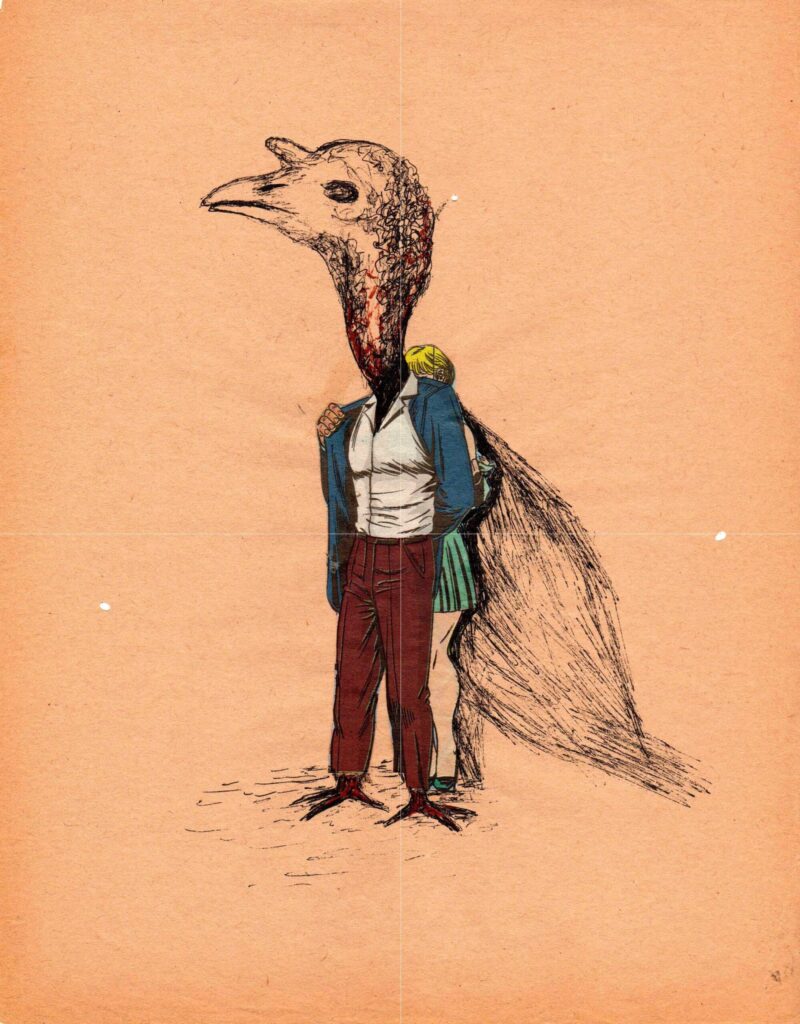
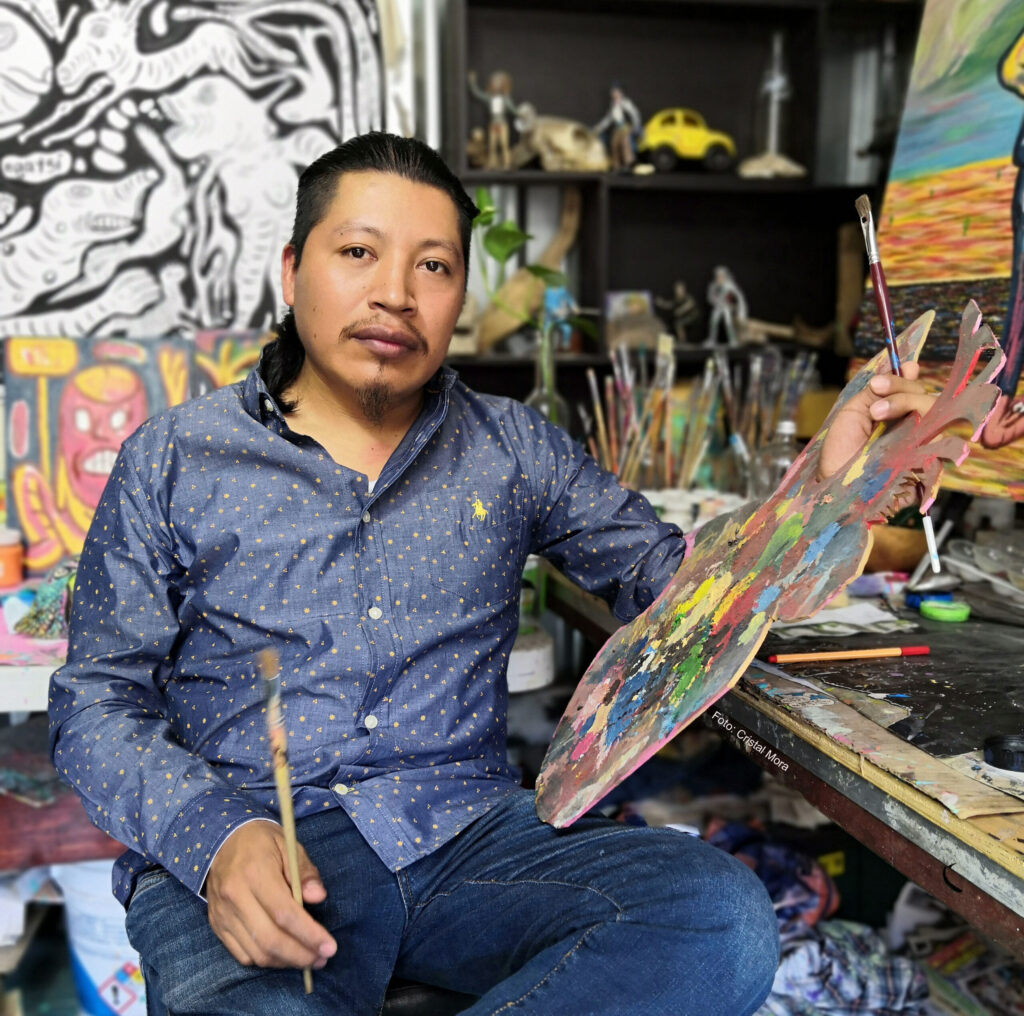
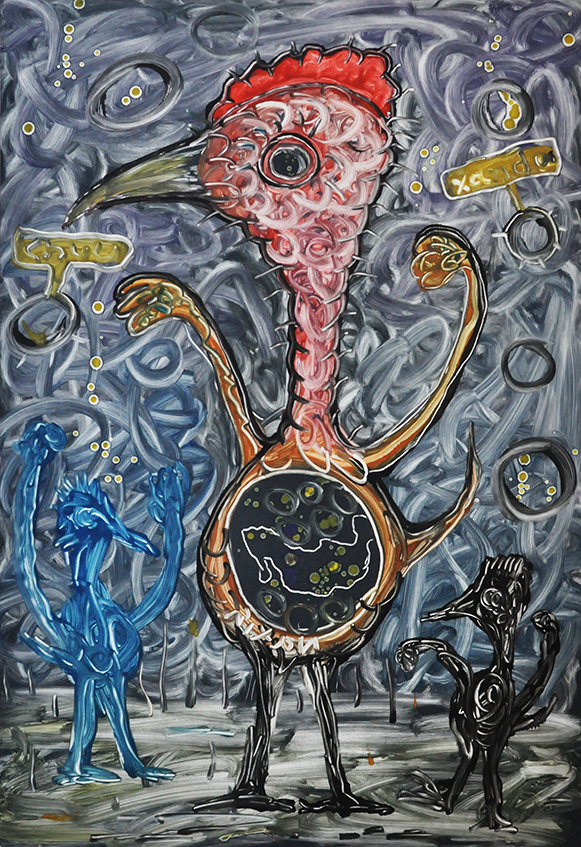
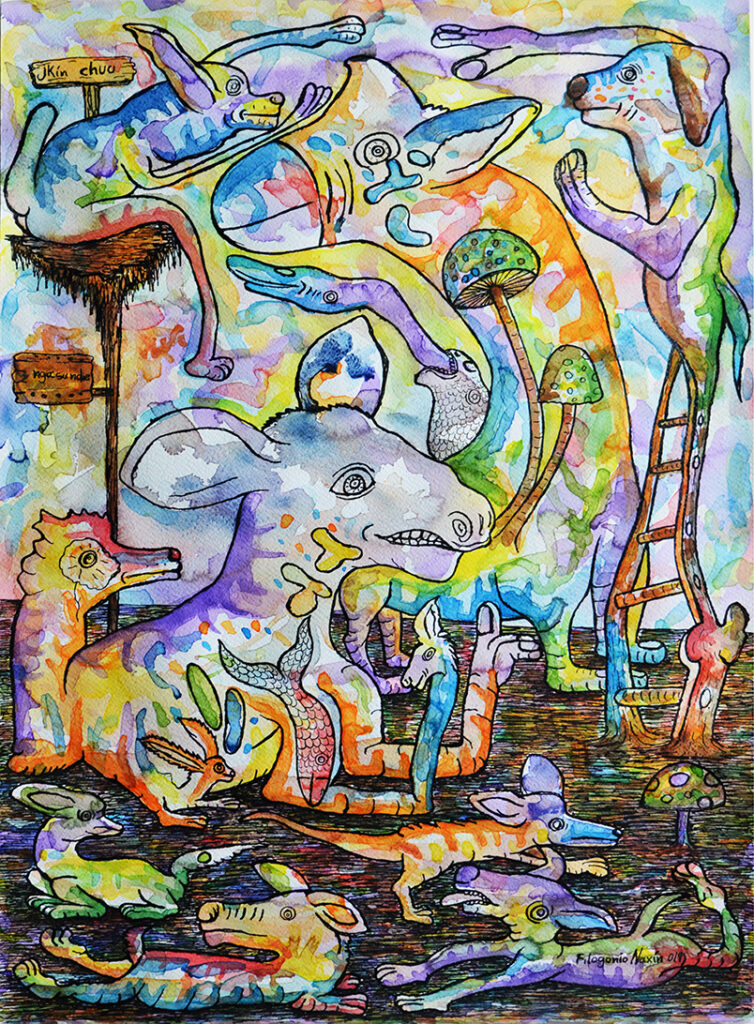
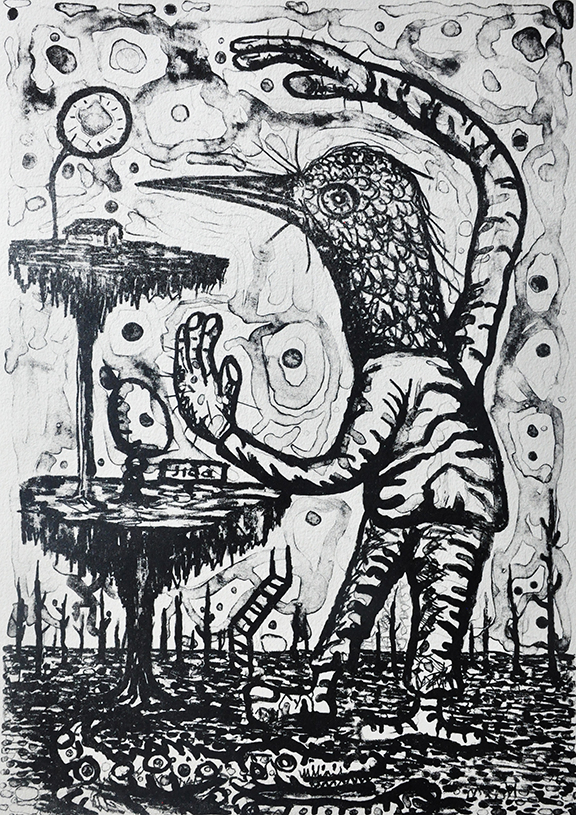
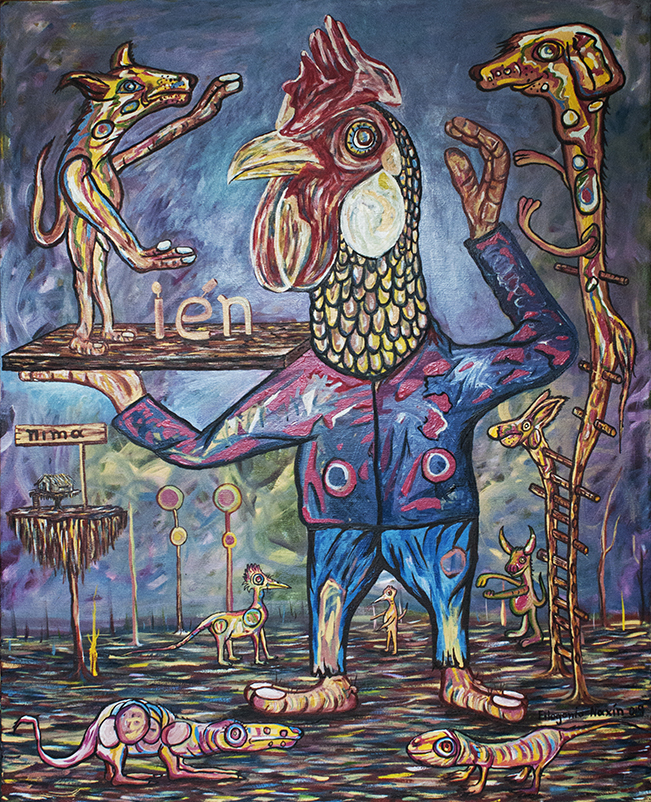
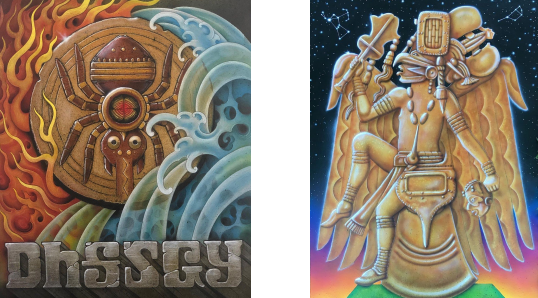
The art of Filogonio Naxín bets upon the freedom of shapes. Reaching beyond galleries, museums and art schools, Naxín dislocates definitions of “traditional” and visualizes bridges in oil, acrylic, and watercolor with which he crosses from the Mazatec language to the techniques of Western art.
Filogonio Naxín is from Mazatlán Villa de Flores, Cañada Region, Mazatec territory in the State of Oaxaca, Mexico. He is a native speaker of the Mazatec language. He has a B.A in Visual and Plastic Arts from the Universidad Autónoma Benito Juárez, Oaxaca. Currently he illustrates books as well as offers painting, drawing and engraving workshops. Nixín has had more than 20 individual exhibitions, among which showings at the Institute of Graphic Arts of Oaxaca-IAGO, the Torre del Reloj Gallery in Polanco, and the INAH National Museum of World Cultures stand out. In 2015, the National Institute of Indigenous Languages published his bilingual book (Mazatec and Spanish), Minu xi kuatsura chichjána, Kui anima xi bantiya yajura / Qué cosa dice mi tata, Seres que se transforman. https://www.facebook.com/FilogonioNaxin
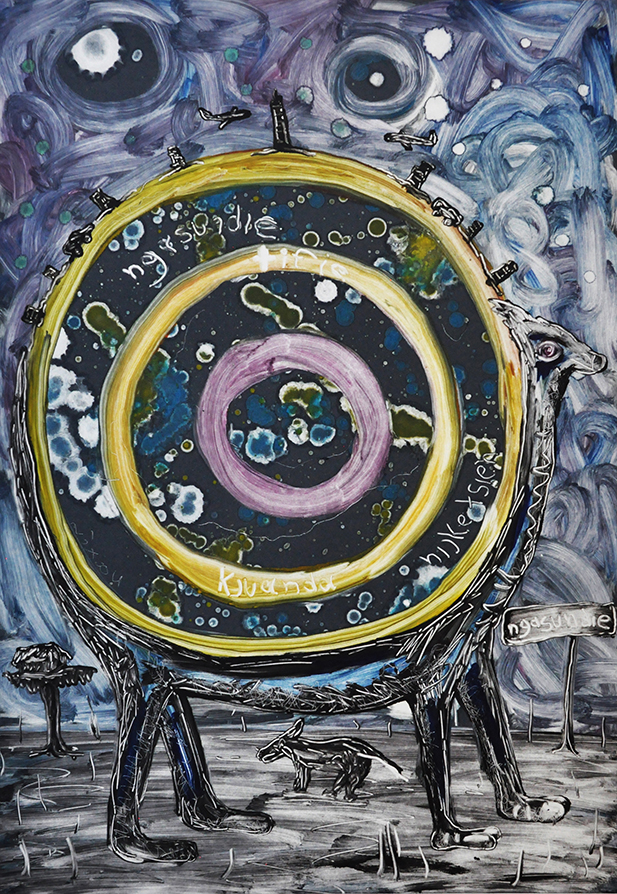
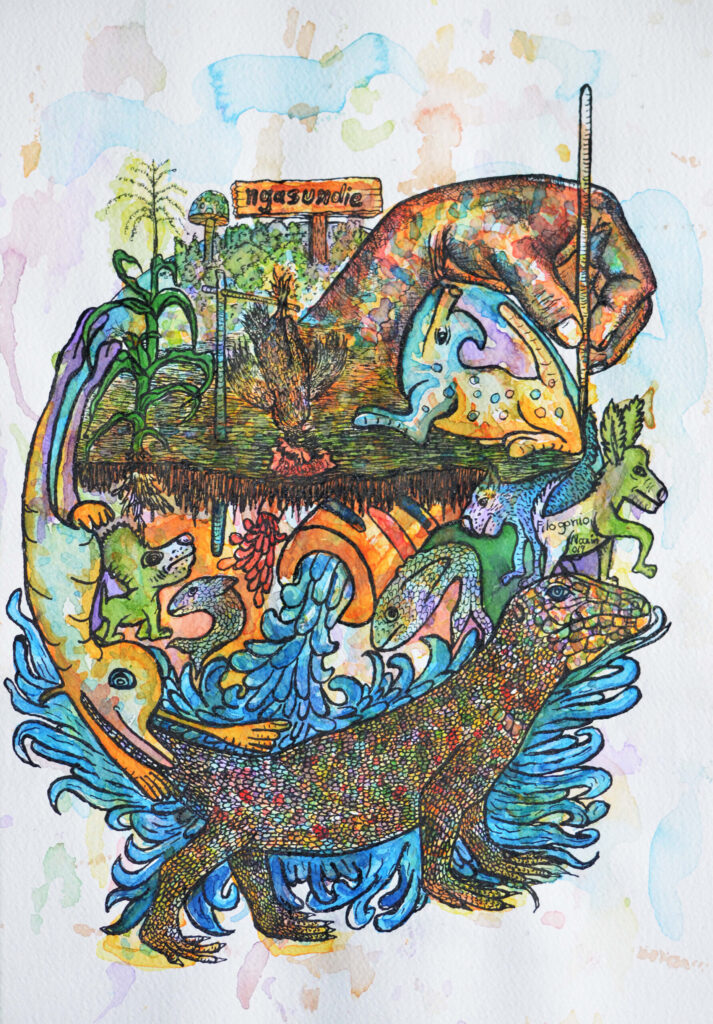
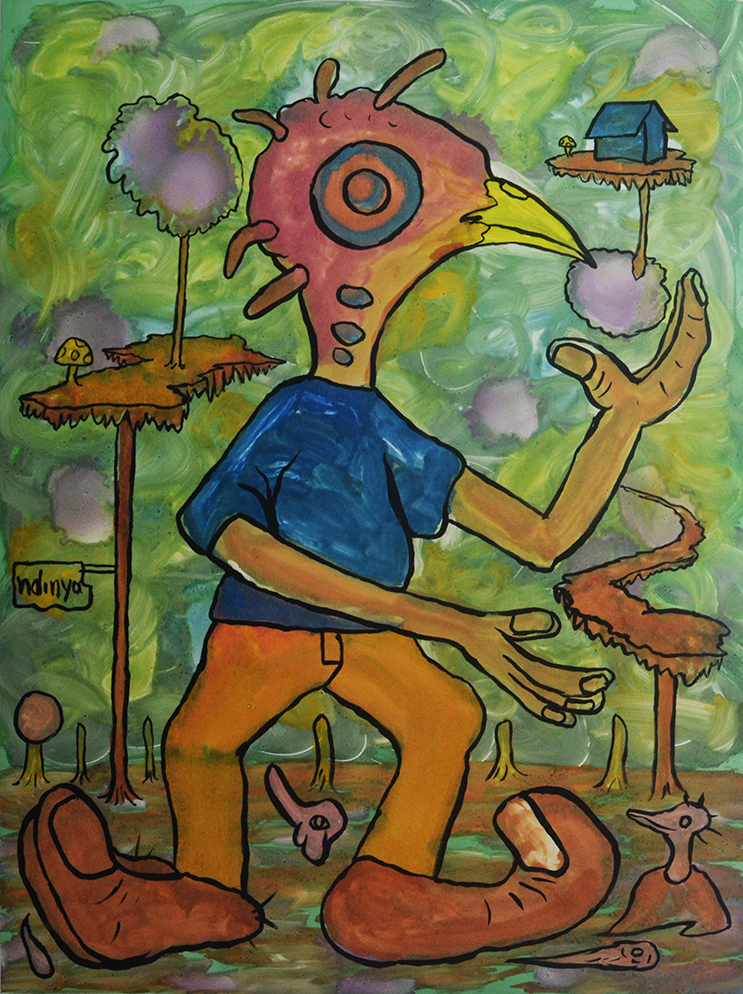
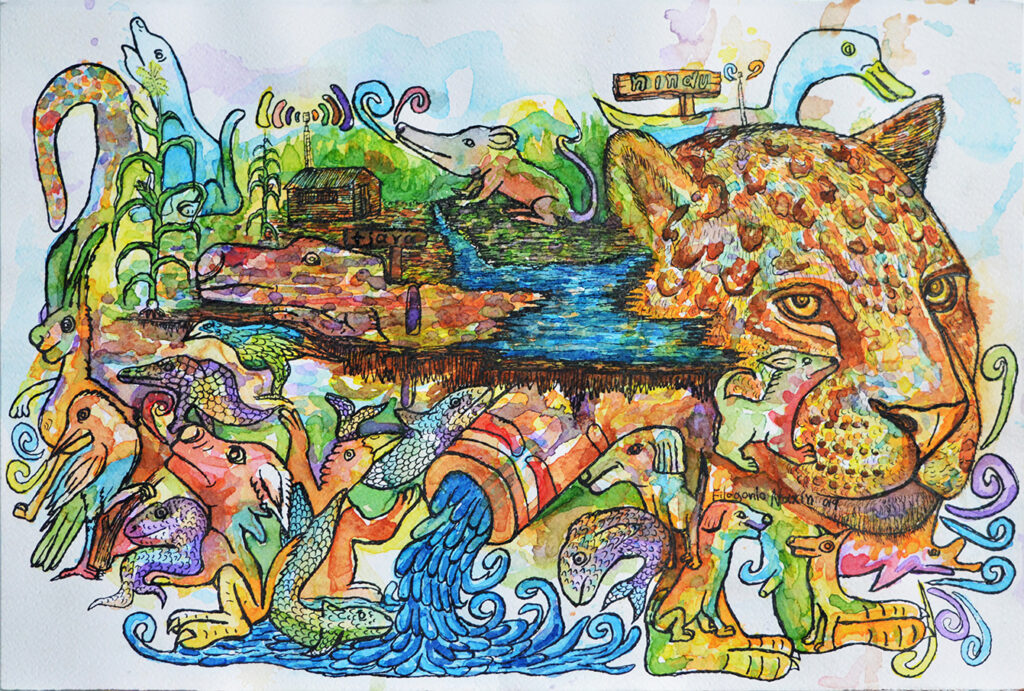
Naxín’s paintings gravitate around characters and landscapes in which human-beings, non-human-beings and more-than-human-beings merge. His last name, Naxín, means the nawal-spirit-horse, a presence in many of his canvases. In the indeterminacy of forms, these paintings invite you to enter a web of beings: a dog is a deer that is a whale that is a mouse that is a dinosaur that is a city. The “holy children” (as María Sabina called the medicinal mushrooms that grow in the mountains of Oaxaca) stand colorfully in this net that binds defined shapes and mystery.
At some point in her experience, the viewer may ask herself: Are these images fantasy? But how can I distinguish “fantasy” from “reality”? Or are these visions another way to represent what has always been there? In any case, it seems that the only way of being in this art is “being-in-between”: as in “Ngansudie / Earth”, where the body of the city is the stomach of a deer in which the Milky Way can be found; or as in “Ién Nima / Mazatec”, where the body of a dog is a ladder standing as a tree. Being-in-between levels, being-in-between bodies.
Suddenly, the viewer transits from amazement to laughter, as Naxín’s aesthetics reveal the fragility of human beings when they believe they are just “individuals”. In “Earth Mother ”, the seed, the corn, the flowing water are spontaneous traces of a hand/mountain full of life.
Naxín’s art has been said to be “surreal”, bringing to mind André Breton’s famous 1938 comment on Mexico: “Mexico is the most surreal country in the world”. However, in this context, what some see as surreal, borrowed from the unconscious or the absurd, is perhaps the opposite: an ancient/contemporary/conscious creativity like the one cultivated for milenia by many indigenous peoples from Abya-Yala (the Americas). Here, at Siwar Mayu, are some examples of this art. Filogonio Naxín’s work is an invitation for new generations to remember and daydream this fabric between languages, aesthetics and worlds.
In February 2020 Siwar Mayu met Antonio Calibán Catrileo and Manuel Carrión at UC San Diego, where they had been invited to the International Symposium of Indigenous Writers and their Critics, organized by Gloria E. Chacón. Singing, weaving, poetry came together in their presentation, from which this message was clear: in destabilizing the colonial structure, its complicity with the hetero-patriarchal system becomes visible. This month in Siwar Mayu we would like to celebrate Catrileo-Carrión Community’s video-essays, as well as share two unpublished texts by Antonio Calibán Catrileo, translated into English by our friend Felipe Q. Quintanilla. Thanks for your work, hermanxs!
In the words of Catrileo-Carrión’s own community:
In Mapuzungun, “epu” and “pillan” mean two and spirit respectively. The epupillan horizon, that is to say of two-spirit people in the Mapuche context, exceeds LGBTIQ+ categories; this is where its radicality lies because it puts sexual dimorphism in tension (…) Epupillan challenges the notion that the body is separated from the spirit; epupillan has lost its fear to cease thinking through binarism and has become a radical experience in the face of the coloniality of gender, therefore tensing the entire colonial paradigm of sex-gender identity constructions. Epupillan is an open provocation to explore diversity, to consider ourselves part of the itrofilmongen (biodiversity).
We could perceive the uncomfortable gaze of the wentru, seeing us together. Me, with my painted nails and dressing with some elements that, as tradition would say with a categorical tone, without the possibility of doubt, only the zomo could wear. During the prayer we had to deal with that: with the mocking and mistrustful looks. Uncomfortable looks, not understanding what I was, what we were. Until the elder women, the papay, came to ask my name and to come out and dance with the men, the wentru carriers of tradition. Fear of rejection, a thing I have felt time and time again, made me want to resist. But there I was, with a muñolonko on my head, wearing it like my sisters wear them, because, indeed, I have always been a female in my community. They never treated me as foreign, or out of place. For a second, I thought of removing myself, but then I felt the call of the papay who called my name once again. One of them said that the choyke purrun would not start if I did not also join them. I took a breath and contemplated the scene for a second: all the heterosexual families coming together around the rewe, and in the one corner was my community comprised by Manuel, Patricia, Consuelo, and Constanza. I saw that Consuelo, for the first time, had taken my kultrun, and started to play it, timidly. My eyes fogged up with emotion that I had never before verbalized. I looked intently at Manuel.
I joined those men, even though I didn’t have the smell of masculinity, but rather of something unclassifiable. I know that they didn’t want me there because I spoiled their performance of virile men emulating the courtship rituals of birds. I didn’t do it for that reason; for me, the choyke purrun was a space and time to derive pleasure from the dance and journey. I saw my community once again. They were there watching me. To them I dedicated this dance and prayer: to the pariahs of identity, the nameless, the faceless, the ones you don’t approach because their genders are not fully known. And I turned around the rewe. I closed my eyes and focused on those first shy percussions that Consuelo was making with my kultrun. Its heartbeat was delicate, sensitive. Different to the ones of the papay, a beat strong and clear, because they were the keepers of the tradition. But I closed my eyes and that sound faded; little by little, I started to feel my heartbeats synchronizing with Consuelo’s rhythm, and I asked the spirits that were visiting us at that moment, for them to dissolve my humanity during that short period of the ceremony. I asked them with every movement of my body for everyone to see me in this moment overflowing, for them to see me in transit through the energy of Antükuram. Our affinity came forth in each turn we did on the rewe. I danced to the rhythm of my community, lest we touch each other or manifest our love publicly. Our dance was not for the sake of difference, but rather a provocation. The mist covered the whole group in prayer, we could only listen to each other and see the spectral silhouettes. But still we knew that we were turning. I took Manuel to the dance, dared to grab his hand even if a man with a man was not permitted. I knew that neither of us was really a man. We were a shared energy that let itself be touched by chiwayantü, the mist. In that porous dance we kissed without touching: Manuel, the mist and I. It was a gesture of love epupillan. Far away we could hear Consuelo playing the kultrun vividly. Something in us had awakened.
~
Wentru: man
Zomo: woman
Papay: women elders
Muñolonko: handkerchief that is tied to the head
Choyke purrun: dance of the ostrich
Rewe: altar, ceremonial space
Kultrun: mapuche drum
Antükuram: egg with no embryo
Chiwayantü: mist
Epupillan: two spirit
“Kizungünewün epupillan / Self-determination two-spirits”, a video-essay by the Catrileo Carrión Community
In Kizungünewün epupillan / Self-determination two-spirits, the Catrileo-Carrión community explores the full force of their epupillan multiplicity through both image and poetry. Epupillan self-determination challenges labels such as “champurria” (mestizo), “warriache” (urban Mapuche), “homo / heterosexual” and “Mapuche”, since the fossilized identities are colonial control weapons for both settler colonialism and internalized colonization. In a prologue and three chapters, Antonio Calibán, Manuel and Constanza self-reflect on how expectations about ethnic/racial classifications obstruct the possibilities of being, marginalizing those who “are not enough”, or who flow between different possibilities. While a spindle spins on the ground, we read on the screen:
They’ve performed a race test on us, they didn’t find the color they expected on our skins, neither in our features nor our hair; they also didn’t find in our names the correct origin or family, and our non-heterosexual relationship just made them uncomfortable. They did not find our mapuchidad pure enough. (4:30)
Performance + Poetry + Video + Ceremony + Moss from the water springs + Stones from a sleeping volcano = Healing for the body, the heart and the multiple spirit.
a life that chooses its present and its abundance.
Never void, never sinful.
There is a world full of beings like us,
We are the angle that opens and closes the circle.
We receive the force of the sun
To beat the prejudices of our people,
to rebelliously burn the place they took away from us.
But we are sprouting forth with the strength of Antükuram
And soon we will come back to dance atop our rewe
To lead the way for our overflowing journey.
~
Papay: women elders
Antükuram: egg with no embryo
Newen: strength
Rewe: altars, ceremonial spaces
About the translator
Western University ’12 PhD Hispanic Studies.
Felipe Q. Quintanilla is an Assistant Professor of Hispanic Studies at Western University, where his research and teaching cover a wide range of topics and genres, including the Salvadoran Post Civil memory and oral history; gender and sexuality in contemporary Latin American cinema and literature; U.S. Latin@ representation in popular media; and Spanish-English translation. His creative works have been included in several print anthologies as well as in various online publications. He was also co-editor of the Indigenous Message on Water that gathered wisdom, thoughts, verses, short stories, poems, and general reflections on the various local issues pertaining to water.
For more about the Catrileo-Carrión Community
Ngoymalayiñ / We don’t forget
Short film about the murder of Matías Valentín Catrileo Quezada in 2008, by a Chilean policeman. Excerpts from an interview with Catalina Catrileo, Matías’s sister, by a journalist who asks incisive questions, are included: “Catalina, do you feel Chilean? Would you like to feel Chilean or would you prefer an autonomous Mapuche state?” The answer: “The state is a repressive institution.” A public acknowledgment of impunity closes the video: a list of names of Mapuche leaders who have been killed during the contemporary Chilean “democracy”.
Famew Mvlepan Kaxvlew / I am here, wounded river
Video-essay/memoir about Antonio Calibán Catrileo’s radical decision of self-determination: changing his name in his birth certificate. The grandmother’s surname, the Mapocho river, and the wixal / loom are witnesses of this “des-whitening” process, in which the Mapuche identity is clearly not homogeneous.
Craig Santos Perez is an indigenous Chamoru poet from the Pacific Island of Guåhan (Guam). He is the author of five books of poetry, co-editor of five anthologies, and professor at the University of Hawai’i, Manoa.
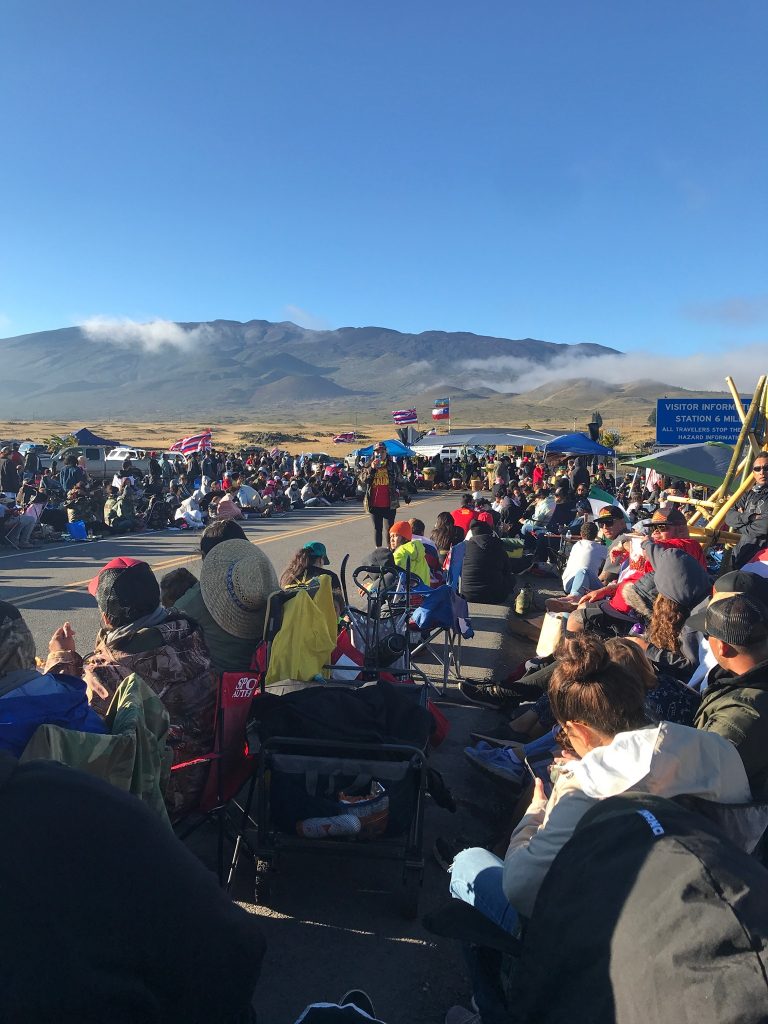
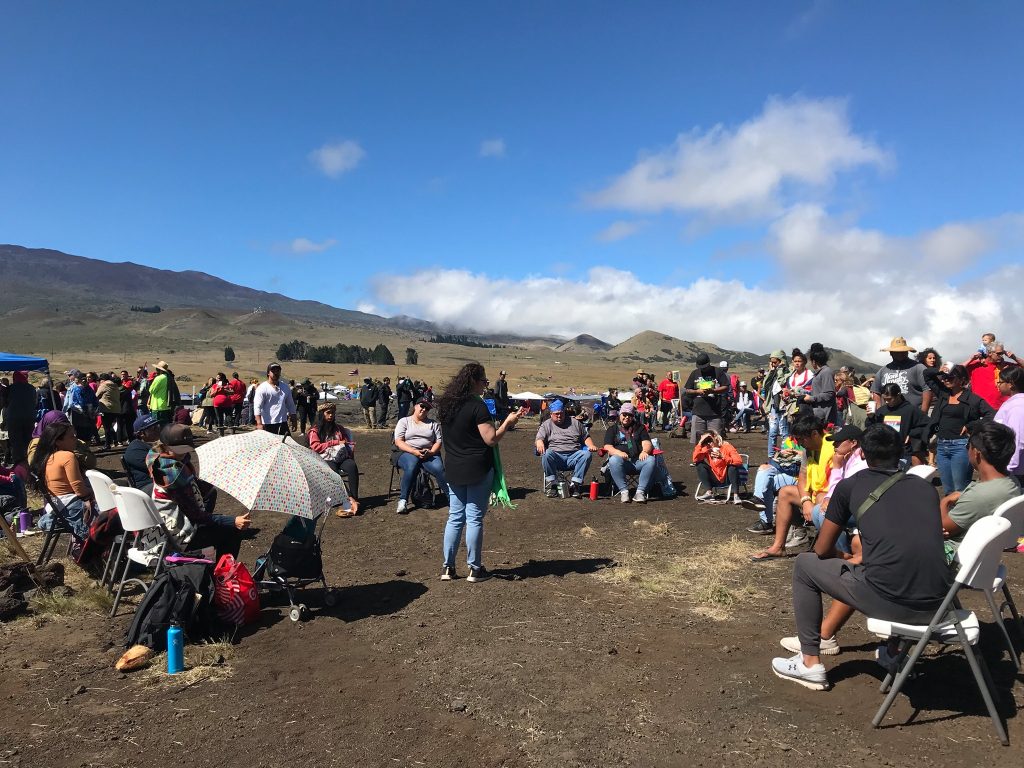
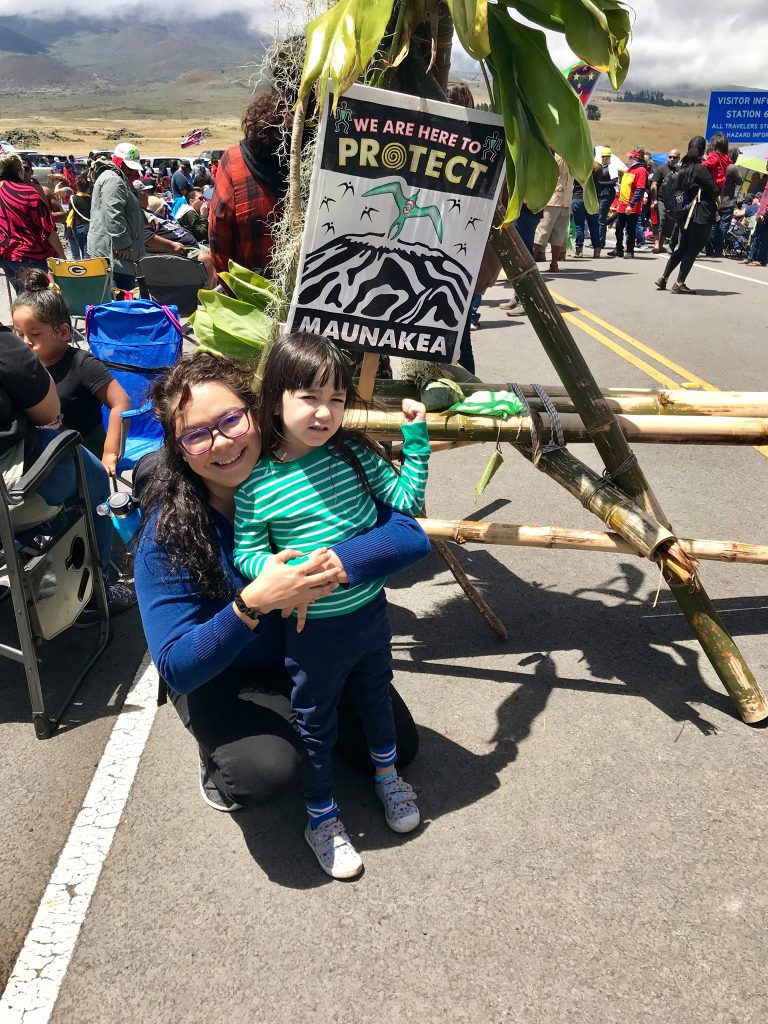
“I wrote this poem for International Mountain Day to raise awareness about the ecological and cultural value of mountains in Pacific islands and cultures, especially since the Pacific is not often imagined as a mountainous region. The poem also responds to historical and ongoing threats to mountains in the Pacific, including mining, deforestation, urbanism, militarism, and tourism. Specific to Hawai’i, I also wrote this poem in solidarity with native Hawaiians who are protecting their sacred mountain, Mauna Kea, from development and desecration by the colonial astronomy industry, who is planning to build the largest telescope in the world atop Mauna Kea. Hawaiians have established an encampment at the access road to the mountain to stop construction, and they have even created a free school there with daily classes, events, dancing, chanting, and other rituals. My wife, who’s Hawaiian, and our family went to the base of Mauna Kea last summer to perform our poetry and show solidarity. I performed “Chanting the Mountains” for the first time there. The pictures depict our experience.”
In bridging pop-culture with land issues and spirituality, indigenous youth have embraced genres such as rap, punk, jazz, graffiti, and heavy metal since the early 1990’s. In the case of hip-hop it shouldn’t surprise us that an aesthetic that was born at the crossroads between Black American, Caribbean and Latinx migrants at a time when the South Bronx, NY was burning, would be adopted by native artists who, as protectors of their lands, have been reminding indigenous and non-indigenous peoples alike that tradition and language must be constantly moving.
Rhythmic lyrics, drums, stomp-dances, pow-wows have been beating for millenia among First Nations from Abiayala (The Americas.) Together with the rich phonetics of glottal and tonal indigenous languages, they have sparked contemporary indigenous hip-hop. Furthermore, acknowledging non-alphabetic writings such as rock-paintings, petroglyphs, geoglyphs, ideograms and textiles, contemporary indigenous graffiti artists are occupying and reclaiming cities, materials and technologies. Today, in activating indigenous beats, languages and codes via hip-hop aesthetics, our guest-artists this month in Siwar Mayu are challenging stereotypes and expectations about indigeneity while empowering women, elders, children and keepers of the land (Juan G. Sánchez Martínez.)
Gonzalo Luanko is an artist of the new Cumbia & Rap Mapuche. As a teenager he started under the pseudonym “Soler Minute,” which he later evolved toward his “Mapuche identity”, adopting his first name as his artistic name. Luanko is a teacher of History and a composer with five albums already released. He has traveled throughout the Chilean territory and has taken his “kimün” (Mapuche wisdom) to other countries such as Uruguay, Argentina and the United States.
DJ. SELTZER
His discography, Inche Ta Luanko (2011), A Pies Pelados (2012), Oral Tradition (2015) and Ketrolelán (2017), contains verses that alternate between Spanish and Mapudungún, reactivating the native language and delivering a message to the new generations for the reconstruction of the Mapuche culture. His lyrics reflect upon the history of the struggle and worldview of his people. Instruments such as the trompe, pifilka, trutruka or kultrún appear frequently in his songs. His latest album called Ketrolelán / I am not silent includes the participation of Movimiento Original, Santa Feria and Spokesman. It was nominated for the Pulsar Awards 2018, in the Native Peoples category, and contains the song “Witrapaiñ / We are Standing” with Portavoz, whose videoclip was made in the Wallmapu / Tierra Mapuche. Luanko’s music evolution has taken him from hiphop to Latin American rhythms and today he is working with DJ Seltzer in a new album of Cumbia-Rap Mapuche.
Kvmeche kvme zungukelu / good people who speak well
Lif piuke lif pulli ngelu / people with clean hearts and spirits
Poyentu nvtram nielu / have sweet conversations
Tañi pulli konki / where my spirit always goesÑi mongen mu liftun zuamki / my life needs to be clean
Liftun mvlele feita rume fali / if it needs to be cleaned, that’s worth it
Norche ngelan / I’m not always correct
Welu kvmeche ngen / but I’m a good person
Rume trani tañi mongen / my life goes down
Welu newenkvlen / but I’m still strong
Inche kimche ngelan / I am not wise
Welu chilkatuken / but I’m always learning
Kelluken ñi pu Che / I always help my people
Fei mu kvzaukvlen / which is why I work
Kvpape feyentun tañi kultruntun / for the belief to come and the kultrun to be played
Kvpape poyewvn tañi ngvlamtun / for the benefits of my advice to come
Lefvlkantun ñi piuke mu / my heart’s fast song
Kom tufachi zungu / all of these Tañi liftun / are how I clean things
Chorus
Kvtrankawvn mvlele / if there is suffering
Kiñe liftun / a cleaning
Afi zungu mvlele / if something ends
Kiñe liftun / a cleaning
Weza zungu mvlele / if there are bad things going on
Kiñe liftun / a cleaning
we newen nieam / to have renewed strength
Verse ll
Inche zuamlan tami koila ngvlam / I don’t need your false wisdom
Inche zuamlan tami vtrir nvtram / I don’t need jealous conversations
Fei ta kvmelay kvmelay kvmelay / that’s not right, not right, not right
Welu lif newen nieiñ aflayai / but we have clean internal strength
Kiñeke lelin neyen ayekan / some looks, breathing, happiness
Kuifike winkul kiñeke trekan / ancient mountains, some strolls
Kiñe llellipun mawvn lelfvn kurruf / a ceremony, rain, the countryside, the wind
Lifko kuifii kvtral / clean water ancient fire
Kom tufachi zungu niey lawen liftual / all of these have the medicine to clean
Kimi tami rakizuam llitual / your thoughts know to begin
Kiñe matetun purrun Datun / a mate, dance, healing
Kiñe yafutun lefkantun / a strengthening, running
Kiñe nampulkan niey liftun / a trip can cleanAkutuy kvme weftun / the rebirth is here
Inkakeiñ taiñ kewvn mongeli / we will defend out living language
Taiñ püllü mu weichatuki / our spirit fights
Taiñ Tukulpan akupe / let our memory come back
Cheu pvle traupaiñ wezache konkilpe / let bad people not enter where we get together
Taiñ trawvn kvme amupe / let our coming together be good
Taiñ liftun afkilpe / let the cleaning not end
Chorus ………
Verse III
Kvpape feyentun tañi kultruntun / for the belief to come and the kultrun to be played
Kvpape poyewvn tañi ngvlamtun / for the benefits of my advice to come
Lefvlkantun ñi piuke mu / my heart’s fast song
Kom tufachi zungu / all of these
Tañi liftun / are how I clean things
Chorus …….
~~~
Zara Monrroy (Comca’ac)
Roxana Sarahí Romero Monrroy was born in Hermosillo, Sonora in 1991. She is originally from the Comca ́ac nation in Sonora, México. She is a composer, poet, translator and writer. She is also an activist and fighter for human rights and gender equity. Zara is committed to preserving and transmitting the lyrical tradition Cmiique Iitom, through song and ritual representation of her ancient knowledge. She combines her own language and way of expressing the message of her ancestors with western genres. As a traditional Pascola dancer, Zara recreates the ancient art of facial painting, redefining it and adding to it new symbolic elements. She practices the ancient art of singing and composing in her mother tongue, Spanish, and English.
Comca ́ac Flag
Regardless, she believes that a well intentioned message doesn’t need translation- it only needs to touch the heart of those that hear it. Currently she is the founder and an active member of the ecology club AZOJ CANOJ that operates within the Comca ́ac territory, and is composed of young women from the Punta Chueca community in Sonora. She coordinates different events and procedures, such as setting up recycling workshops and waste management.
/ You, human that walks and breathes, why don’t you do the same, be thankful with everything and everyone, send good vibrations to the animals, to the people, with nature, that is calmness and happiness, harmonious with what you desire and ask for and everything will unfold.
One day you’ll know everything is temporary, but it is truly worth it, be thankful. Aren’t you a human that feels? Life is human, emotions and feelings, but this is real.
/ When you walk to the edge of the sea, be yourself, surrender with your heart in order to be and experience life as it is, everything is beautiful, the sea is beautiful, the sky is beautiful, the earth is beautiful, send positive vibrations and connect.
Taax sacaha taax ziix quipee caha insocta aha.
Hant quiij consacaixaaj aha.
/ that’s how this is, everything is good when we know we are in the right place, be yourself and thank the earth where you step .
(spoken at the end)
~~~
Tall Paul (Anishinaabe / Oneida)
Tall Paul is an Anishinaabe and Oneida Hip-Hop artist enrolled on the Leech Lake reservation in Minnesota. Born and raised in Minneapolis, his music strongly reflects his inner-city upbringing. From personal expressions of self, to thought provoking commentary on issues affecting Indigenous and diverse communities as a whole, Tall Paul’s music evokes a wide variety of substance and soul.
Ivan Melchor was born in Charlotte, North Carolina in 1997. Presently he studies history at the University of North Carolina Asheville. He has published his undergraduate thesis regarding the migration of Latinamericans to the western region of North Carolina. In 2019 he assisted in a project with the UNCA Department of Languages and Literature to translate a collection of interviews of immigrants from Asheville, N.C. USA.
Paul M. Worley is Associate Professor of Global Literature at Western Carolina University. He is the author of Telling and Being Told: Storytelling and Cultural Control in Contemporary Yucatec Maya Literatures (2013; oral performances recorded as part of this book project are available at tsikbalichmaya.org), and with Rita M Palacios is co-author of the forthcoming Unwriting Maya Literature: Ts’íib as Recorded Knowledge (2019). He is a Fulbright Scholar, and 2018 winner of the Sturgis Leavitt Award from the Southeastern Council on Latin American Studies. In addition to his academic work, he has translated selected works by Indigenous authors such as Hubert Malina, Adriana López, and Ruperta Bautista, serves as editor-at-large for México for the journal of world literature in English translation, Asymptote, and as poetry editor for the North Dakota Quarterly.
Juan G. Sánchez Martínez, grew up in Bakatá, Colombian Andes. He dedicates both his creative and scholarly writing to indigenous cultural expressions from Abiayala (the Americas.) His book of poetry, Altamar, was awarded in 2016 with the National Prize Universidad de Antioquia, Colombia. He collaborates and translates for Siwar Mayu, A River of Hummingbirds. Recent works: Muyurina y el presente profundo (Pakarina/Hawansuyo, 2019); and Cinema, Literature and Art Against Extractivism in Latin America. Dialogo 22.1 (DePaul University, 2019.)
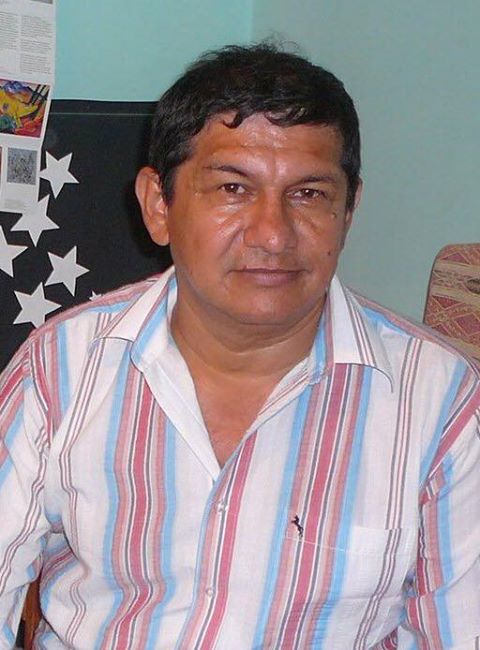
Miguelángel Meza is a Guaraní poet and cultural promoter born in Caacupé in 1955. He has contributed to numerous anthropological and linguistic research studies, as well as translations. He also worked for the National Ministry of Culture of Paraguay. He has published the books Ita ha’eñoso (1985), Perurima rapykuere (1985 and 2001), Purahéi (2001 and 2011), Chipi Gonzales guahẽrã (2006), Maleõ (2007), Perurima pypore (2010), and Arami mburukujaguýre (2012). He is the founder of the cartonera press Mburukujarami Kartonéra, with which he has published numerous titles authored by him and others.
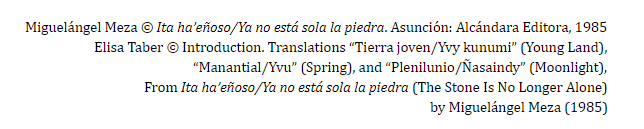
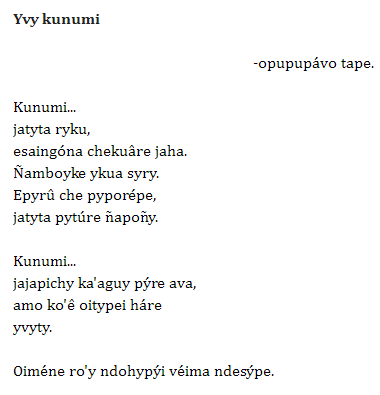
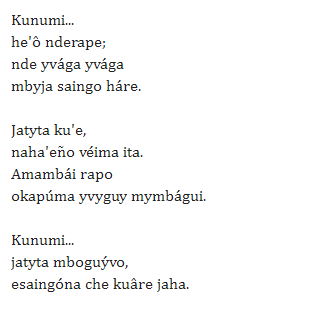
Ita ha’eñoso is a bilingual, Mbya Guaraní and Spanish, collection of poems by Miguelángel Meza. Mbya Guaraní is distinct from Jopara, a variant of Spanish-inflected Guaraní spoken widely in Paraguay, a bilingual country, Spanish and Jopara. This, his first book, published thirty-five years prior, is a twin collection to Ayvu Rapyta, the Mbya Guaraní sacred myths of origin transcribed and collected by Paraguayan ethnologist León Cadogan. He writes a self-reflexive response, not retelling, of the myths; therefore, while his images, symbols, and metaphors refer to an ancestral culture, they are also very much his own. Meza’s words are signifiers without hierarchy that mean literally within the lyric structure, the first words by a new author, and connote literally Mbya Guaraní cosmological narratives. In essence both are the same as the word “ñe’ë,” which literally translates “word-soul.” The origin of the world is not announced by the materialization of the hummingbird, but by a voice that mournfully asserts, “I appear.”
Since Ita ha’eñoso (1985) Meza has published six collections of poetry and short fiction. However, Ita ha’eñoso remains a seminal work in Guaraní poetry because it marks the transition from oral and communal to chirographic and authorial literature. He makes an attunement to both an authorial style and a millenary culture possible, while they jointly point to another way of conceiving the world. The counterintuitive way that this poet renders the individual from the communal is reminiscent of the Paraguayan embroidery technique, ñandutí. Ñandutí means spider’s web in Guaraní. Threads extracted from, rather than woven into, a fabric trace a geometric pattern. Meza imitates this practice by claiming authorship through his lyric synthesis of a communal narrative. Meza seems to say through those that came before him: identity lies in erasure, not mark-making.
Elisa Taber is an Argentine writer and anthropologist. She explores the ontological poetics of Amerindian literature. Her stories and translations are troubled into being, even when that trouble is a kind of joy. Her writing appears in specialized media, such as 3AM Magazine, Colleex Open Formats, and Minor Literature(s). She is the recipient of two Library of Congress Hispanic Division Huntington Fellowship and a Janey Program for Latin American Studies Fellowship; and holds an MA in anthropology from The New School for Social Research. She is co-editor of Slug, a journal that bridges the gap between literature and ethnography, and editor of a Guaraní poetry issue for Words without Borders. Her books include 300 and 28 (Oakland: Gauss PDF, 2019) and An Archipelago in a Landlocked Country [Minneapolis:11:11 Press, (forthcoming) 2020]. Elisa was born in Asunción, and lives between Buenos Aires and New York.
Kimberly L. Becker is author of the poetry collections Words Facing East; The Dividings (WordTech), and Flight (forthcoming, MadHat Press). Her poems appear widely in journals and anthologies, including IDK Magazine, Panoply, and Tending the Fire: Native Voices and Portraits. She has held grants from MD, NC, and NJ and residencies at Hambidge, Weymouth, and Wildacres. Kimberly has read at venues such as The National Museum of the American Indian, Washington, DC and Wordfest and served as mentor for PEN America’s Prison Writing and AWP’s Writer to Writer programs. www.kimberlylbecker.com
To introduce these poems, Kimberley sent to Siwar Mayu this statement about her art, a powerful invitation for the younger generations:
“As a mixed race poet identifying Cherokee, I neither presume to speak for any sovereign nation nor identify with the dominant culture. I am undocumented and describe this experience in an essay for the upcoming anthology Unpapered co-edited by Diane Glancy and Linda Rodriguez.
My work is influenced by my attempts to honor my heritage through the study of language, culture, and history. I look to my literary elders and betters, such as the brilliant Allison Hedge Coke, who taught me to “hold the door open” for others and so I seek to give back where I can.
If, as Tillie Olsen wrote, “every woman who writes is a survivor” and if, as Audre Lorde wrote, “so we speak, knowing we were never meant to survive,” then every writer of Native descent, documented or undocumented, is not only a survivor, but also a witness against the institutionalized racism still pervasive in this country. The Holocaust happened here, as well; Andrew Jackson’s visage is on our currency and his portrait hangs in the Oval Office of our current corrupt president.
Thankfully we have Joy Harjo as Poet Laureate, the first Native American poet in that role, an important cultural corrective. Read the work of her and so many Native writers who are of the land and speak wisdom from ancestors who were here first. Raise up young writers. Hold the door open. Make your writing an offering. Pray. Praise what you can. Call out injustice when you see it. Call on the strength of generations of people who were never meant to survive, but have. “
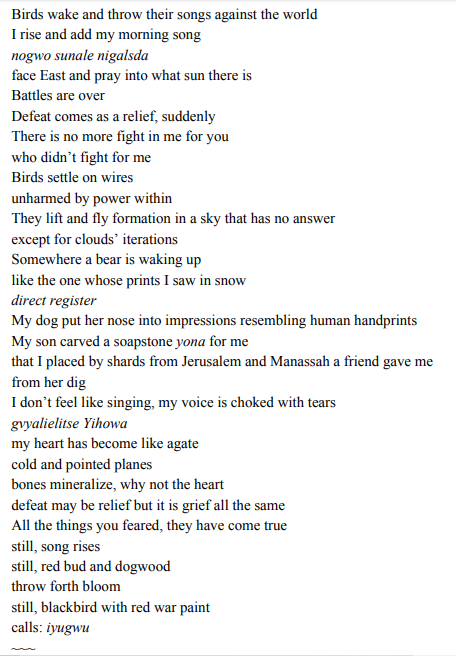
“Morning Song”: Facing East, a song of praise is offered in the morning. Nogwo sunale nigalsda (now morning has come). Yona (bear) Gvyalielitse Yihowa (I am thankful to you, God) iyugwu (Bring it)
John Henry Gloyne, Eastern Band of Cherokee Indian (EBCI), grew up in the Yellowhill community of the Qualla Boundary in Cherokee, NC. Born to a Cherokee father and a Pawnee/Osage mother from Tulsa, Oklahoma he is a prolific artist using several mediums to blend traditional indigenous images within modern contexts. Tattooing, painting, drawing, and sculpting are his main outlets of expression. John Henry’s most well-known works include his own take on traditional Cherokee masks and Mississipian inspired gorgets.
His work has been most recently featured in the Renewal of the Ancient art exhibit of the Museum of the Cherokee Indian and the Appalachia Now! exhibit at the Asheville Art Museum.
You can check out more of his work HERE, and on instagram.
John Henry and I met on a sunny, brisk morning at a small coffee shop in the River Arts District of Tokiyasdi “The place where they race” known by its more popular colonizer name of Asheville, NC. Former industrial buildings turned art galleries, coffee shops and micro-breweries sprawl out along the French Broad River that runs northeast through the city. We both live and work within or near urban spaces associated with Tokiyasdi. I am an enrolled member of the Cherokee Nation of Oklahoma who directs the American Indian & Indigenous Studies program at the local university while John Henry is the owner of Serpent & the Rainbowtattoo shop located in the western part of the city.
I heard about John Henry for years from friends who he played basketball with and from students who raved about his work, both painting and tattooing. We finally met-in-person when he and his partner were taking Cherokee language classes at the local university and I came to sit-in on the class from time to time. I was immediately taken by his work, his love of basketball and his family’s passion for Cherokee history and culture. For my 40th birthday I got my left forearm with my Tsalagi ‘Cherokee’ name in syllabary at his shop. The Cherokee writing system known as syllabary was invented by Sequoyah in the 1820’s and eventually led to the first bilingual Native American newspaper, the Cherokee Phoenix, in the United States.
Adasdelisgo’i “One who continuously helps”
During our morning together we talked art, politics, language, and another of our shared interests…basketball. The following is a brief excerpt of our conversation which highlights his work, his inspirations, and how fatherhood has shaped his craft.
Trey: Do you feel that there’s a Pawnee-Osage influence in your art or do you feel like its mainly Cherokee?
John Henry: Now, I think there’s a big Mississippi influence. That’s the umbrella of all of us in the southeast. Even beyond the southeast too. I think all tribes can relate to the iconography. I would definitely say at the moment, more Cherokee leaning. I even tried a little bit to get out of the Mississippian thing… just cuz I was using it all the time.
Anikituwaghi, 2018, acrylic Man on Mound, 2018, acrylic
Trey: When you were growing up when was the first time when you considered yourself an artist? Were you always drawing and stuff?
John: Always, yes. Always, as I had a very encouraging mother. Honestly, I can’t remember a time when I was not being creative like that. Seriously don’t remember. Mom kept all my drawings since I was like five, six.
John Henry Gloyne, Age 5, 1988.
One of the big things that I ever did was I was just always drawing. My mom was always encouraging me to draw. I drew at school when I shouldn’t have been drawing.
Spud Webb, 1995, pencil and ink.
Trey: Do you have other family members that are artists?
John: Yes, my sister was a big influence on me. She went to the Institute of American Indian Arts (IAIA) and that’s why I went there because she turned me on to it. As she got older– I would imagine with a lot of people that are creative when they’re younger and then adulthood slows it. Just because you’ve got bills to pay and that kind of shit. I think I was a little bit more reckless with it like, “I don’t care about bills. I’m still doing this.”
I threw caution to the wind and just dove into doing art and fucking got lucky and it worked out for me. She painted, but she also did a lot of collage stuff. Just a mix- mixed media, collage, paint, she did a lot of that kind of stuff. She was a big influence on me though. She’s still creative in her own way. She was always funky.
Cherokee and Creek: Indian War. 2016. watercolor.
Trey: How did she influence you?
John: She was a grind metalhead. I never got into that, but it was like, the aesthetic was always around. She loved [the band] Jane’s Addiction. All that was a big influence on me. Their album covers and stuff. That Nothing Shocking record that has two paper mache women and they’re like Siamese and their heads are on fire. Anyways, that was kind of the stuff my sister was into. She would show me all that stuff and she would be like, “Check out the art on this.” It’s cool, it’s awesome or whatever and then I’d trip on it. I was nine. That was a big influence, for sure.
Trey: How’d you get into tattooing?
John: I started learning to tattoo in 2001, I was still in high school, man. I remember I was working at Peter’s Pancakes in Cherokee, bussing tables with my sister. The owner of a local tattoo shop came to one of the high school art shows in Cherokee, He’d seen some of my stuff, asked me if I wanted an apprenticeship. I just immediately quit the bussing tables job and I just got real heavy into tattooing for almost 10 years. Not that I didn’t paint, but it was just strict, like real folks doing tattooing. Looking back, it was like, all I wanted to do was wake up and be creative. That’s all you had to do.
Trey: Do you have a particular style of tattooing?
John: I’m extremely versatile tattooer. I can do a lot of different styles. Maybe that is my style.
Trey: You tattooed in Minneapolis for a bit right?
John: Yeah, well, I got a job, but I picked up and moved almost immediately. I tattooed in South Minneapolis and East Lake Street and just a native would come in and it was just like a trip cuz I didn’t realize how huge the native community was there until I moved there. I tattooed Clyde Bellecourt that helped started AIM [the American Indian Movement organization]. Yes, I got to know his son Crow. He had a powwow group called The Midnight Express. Crow knows a lot of powwow heads from Cherokee.
Anyways, but it was awesome and on top of the native community, just the arts in Minneapolis are huge. It’s a very art hungry town. It was awesome. They call it, “Concrete Rez”, which is just right there in the middle of downtown Minneapolis. I think it’s called Red Earth. Anyway, it’s just like a little rez. It’s right in the middle of the city, it’s all just like concrete housing and stuff.
Seven Clans, 2018.
Trey: Why did you leave?
John: It was too far from home. I’m close to my family. I didn’t want to be a stranger to my nephews and nieces, because I got 12 nephews and nieces. We’re all close. I love Minneapolis, though. Too far from home, though.
Trey: You’re painting more now?
John: All the time. I actually paint more than I tattoo and I tattoo a lot. I’m just constantly doing something.
The process of weeding out, 2018, acrylic
Trey: How do you describe your painting style?
John: Yes. Like most oppressed people, their anger and oppression makes them hilarious. I joke around a lot. I’m a real fun person, but it’s you’re just hiding your fucking anger. [laughs] I feel like– It’s like the more angry you are, the funnier you are. The more darkness there is, the funnier you are. It’s getting to the point where that has a lot to do with my artwork.
Bernini’s son, 2016, acrylic and gouache.
Trey: Does it?
John: Yes. Which is funny, because the past few years I’ve just been painting things to me that are just tame. It’s almost like, I just want to show people, I can do that. But there’s still a bleakness to it, I think. Just a little bit of darkness to it.
Dogdick, 2019, acrylic.
Trey: Do you as an artist, do you feel this pressure that some people talk about, doing so called, “native art”?
John: See, I was so against that when I was younger. Yeah. I was like,” Fuck you, I’m not going to paint a horse or painting” or like, “I’m not painting a fucking Indian doing some shit.”
Tattoo Flash, 2019, acrylic and ink.
Trey: You were resisting.
John: I was resistant as fuck. I’m a genetic dissenter, it’s like– It’s in my blood to just be like, “No man, I’m not doing what you want me to do.”…but really, me doing more Native American type stuff, everything changed when I had the kids. I was probably was thinking about it before I had kids, but then when I actually had them, I was just wanting them to be more aware of who they are, but also be really proud of it. For Cherokee people too, especially Eastern Band, we’re the end of the line here…
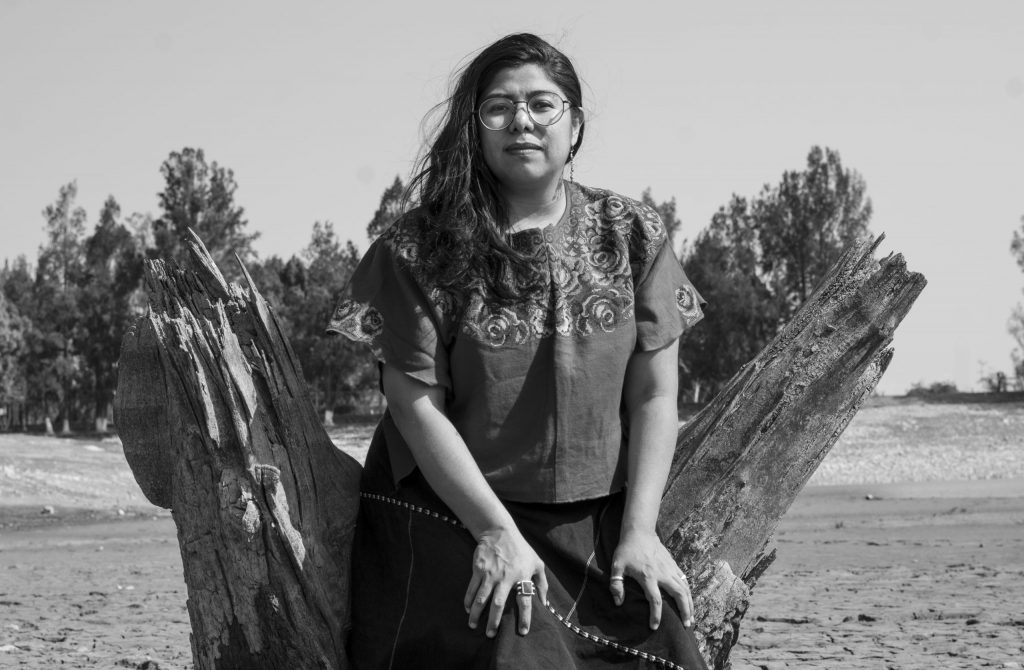
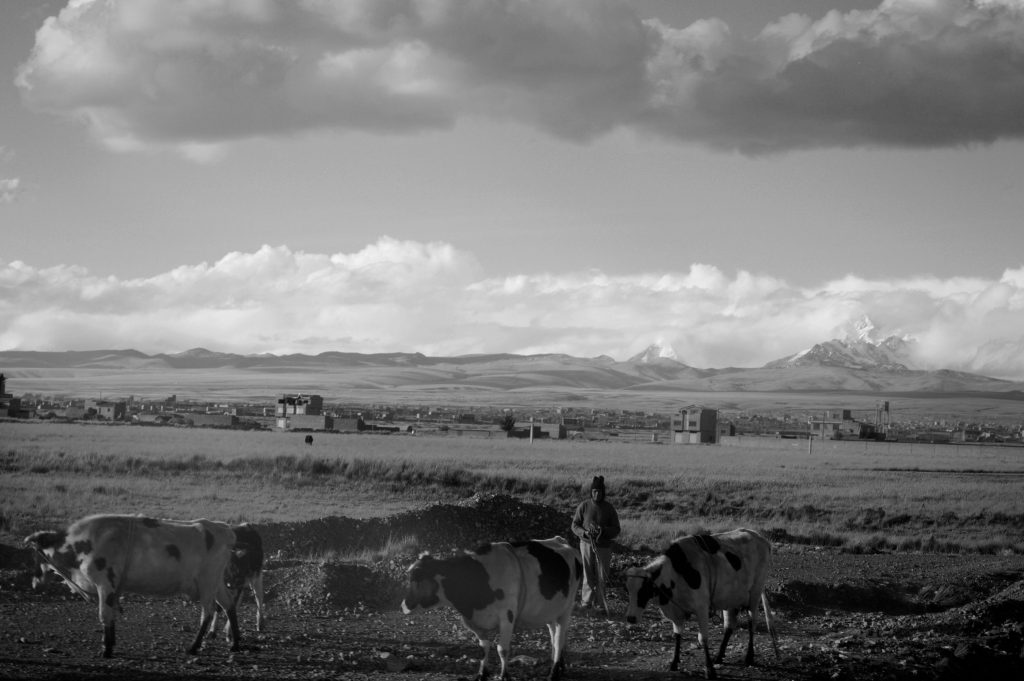
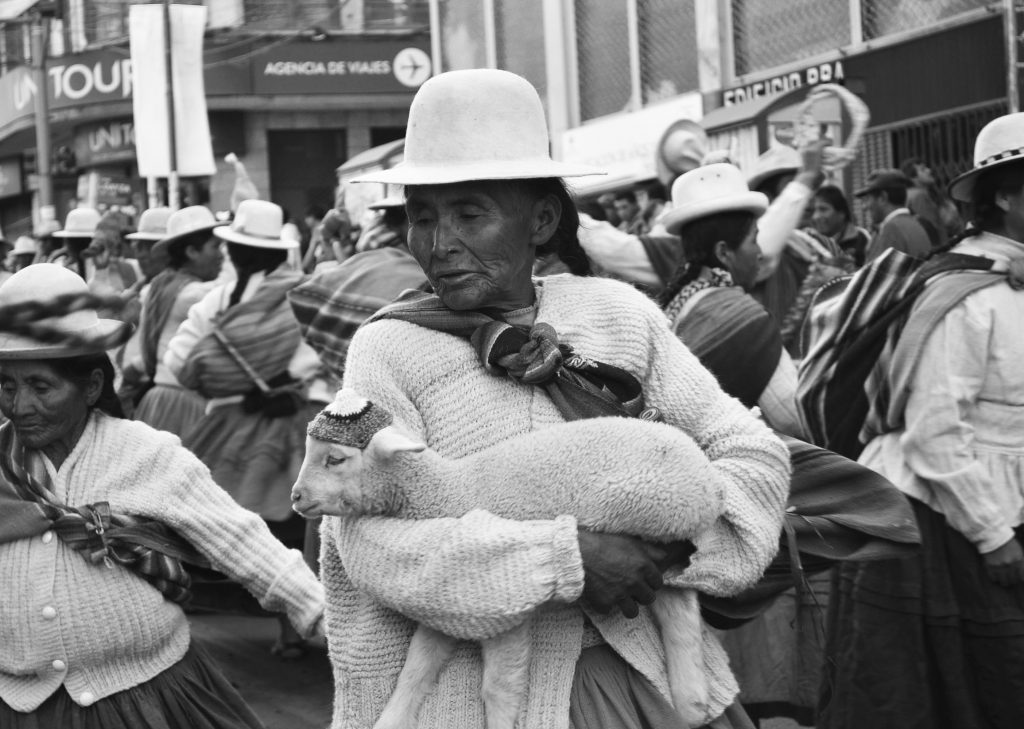
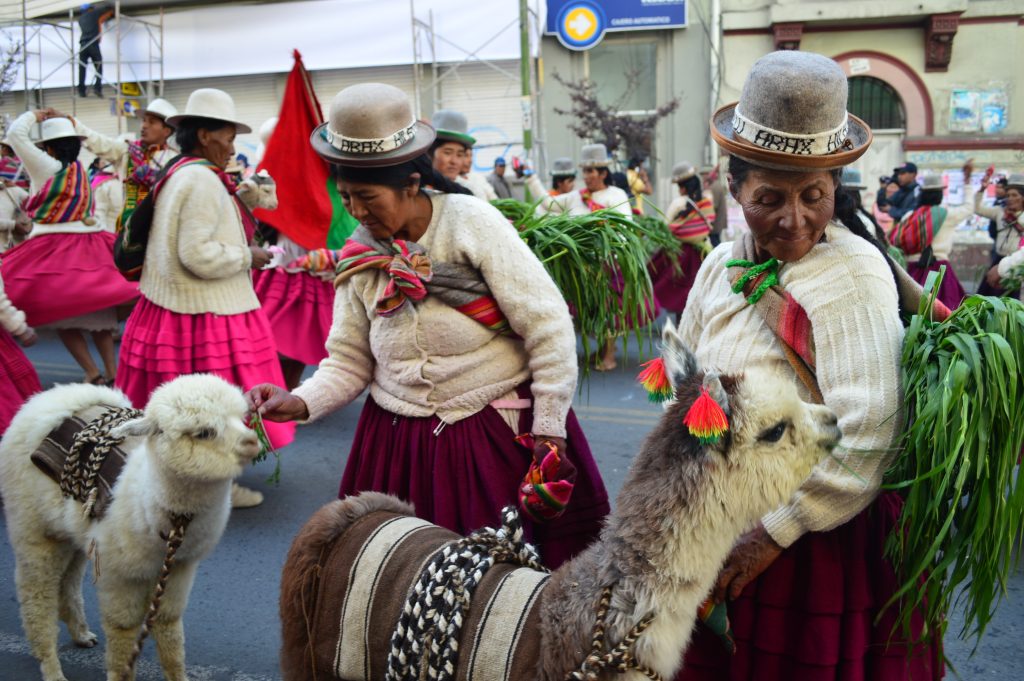
Judith Santopietro was born in Córdoba (Veracruz, México) in 1983, though she was also raised between Ixhuatlán del Café and Boca del Monte, native communities in the Altas Montañas to which her family belongs. There she first heard stories about nahuales, chaneques, flying women, and other extraordinary beings from the Mesoamerican world. Her mother tongue is Spanish; neverthe- less, she has learned Nahuatl for political reasons and to honor her foremothers who dreamed and lived in that language. Judith holds a Master’s degree from the University of Texas at Austin and has carried out research residencies in the Sierra de Zongolica and Tecomate (Veracruz), the Teresa Lozano Long Institute of Latin American Studies (Texas), and the University of Leiden (The Nether- lands), as well as in New York and Bolivia.
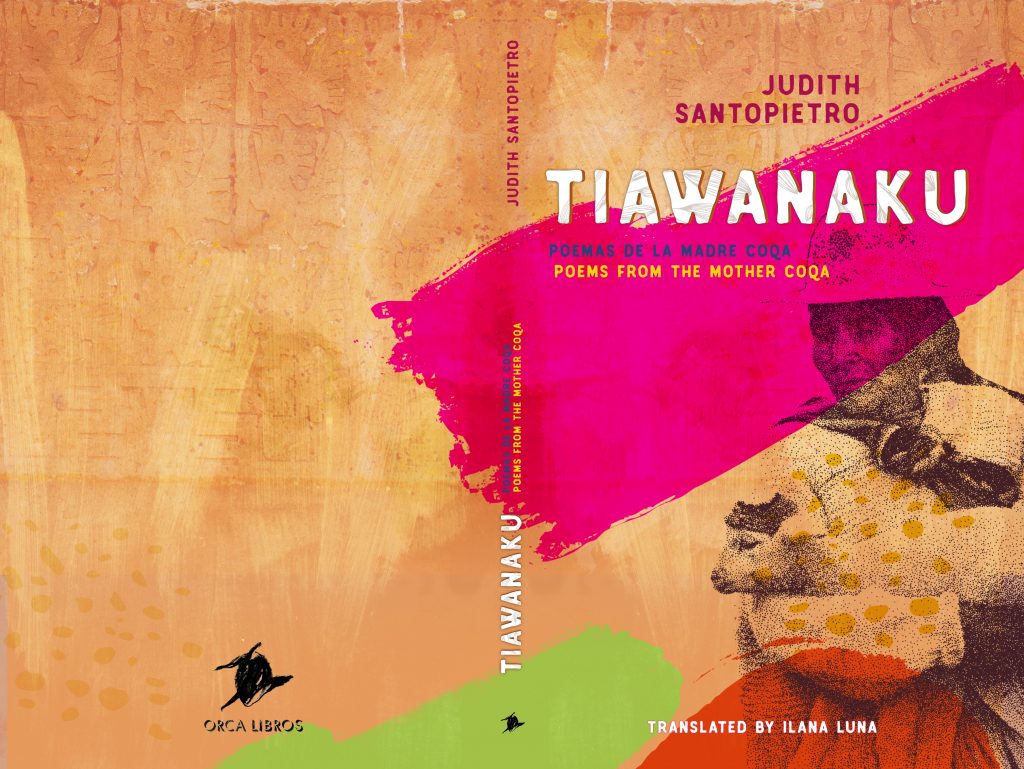
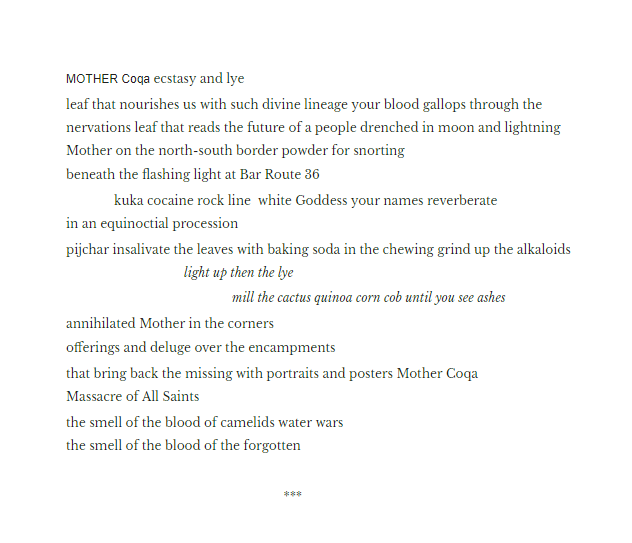
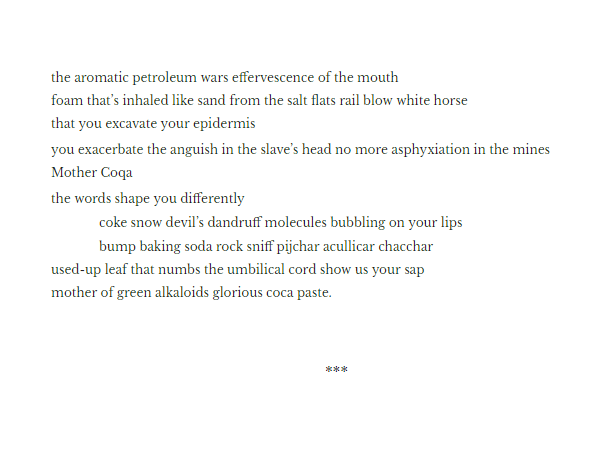
She has published the books Palabras de Agua (Instituto Veracruzano de Cultura-Praxis, 2010) and Tiawanaku. Poemas de la Madre Coqa (Hanan Harawi Editores, 2017) —the first version in Spanish—, as well as the essay “Migran- tes nahuas celebran a Santiago Apóstol: un ejercicio de comunalidad en Nue- va York” (Universidad Autónoma de Chiapas, 2017/ Leiden University Press, 2016). She was awarded the Lázara Meldiú National Poetry Prize in 2014 and was a finalist for the International Literary Prize “Aura Estrada” in 2017. She has published in the Anuario de Poesía Mexicana 2006 (Fondo de Cultura Eco- nómica), Rio Grande Review, La Jornada and The Brooklyn Rail, and has also par- ticipated in numerous festivals, including PEN America’s World Voices Festival in Nueva York, 2018.
Her passions are the project Iguanazul: Literature in Indigenous Languages, photography, participating in traditional rituals and dance, birdwatching, and leafing through her rice paper book of poetry from the Tang Dynasty in Chinese ideograms. Currently, she is writing narratives of migration about indigenous communities in the US.
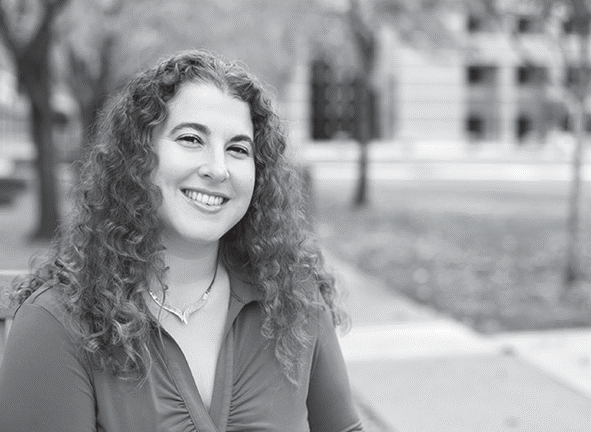
Ilana Luna is a nomad at heart, and has lived on both coasts of the U.S. (Pennsylvania, New Hampshire, California); Miramar, Bs. As. Argentina; Mexico City and currently calls Phoenix, Arizona home, where she is an Associate Professor of Latin American Studies at Arizona State University. She has been a mother, a lover, a poet, singer, novelist, educator, activist, cooking enthusiast, and translator for the last two decades. She holds an M.A. and Ph.D. in Hispanic Languages and Literature from the University of California, Santa Barbara, and came into her unrepentant and intersectional feminism at an early age, culminating in an undergraduate degree from Bryn Mawr College, in Pennsylvania, where she was born. She is also a life-long cinephile, and writes about women filmmakers in Latin America (and the world). She is the Programming Director of Femme Revolution Film Fest in Mexico City, and has written Adapting Gender: Mexican Feminisms from Literature to Film (SUNY Press, 2018). Among many loose publications of poets and essayists, she has also translated several books of poetry, including Juan José Rodinás’ Koan Underwater (Cardboard House Press, 2018) and Giancarlo Huapaya’s sub verse workshop (Lavender Ink, 2019).
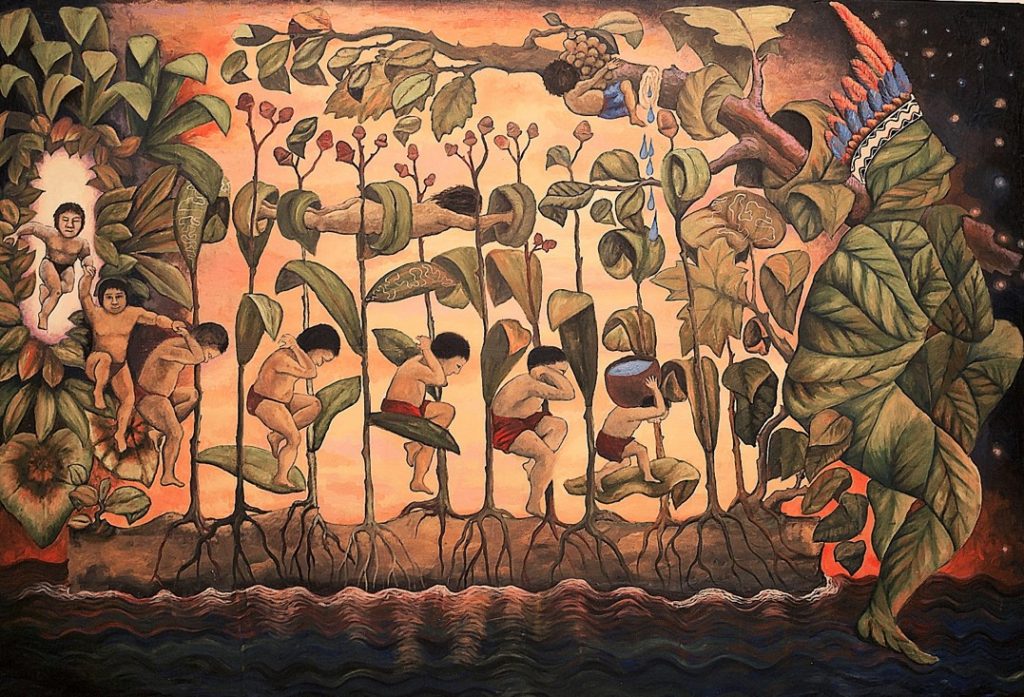
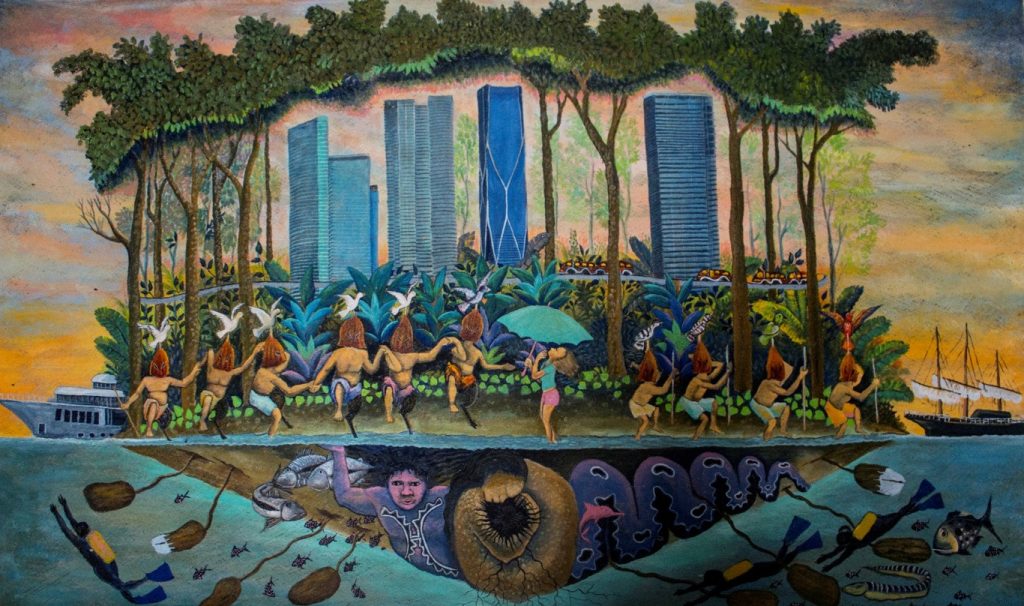
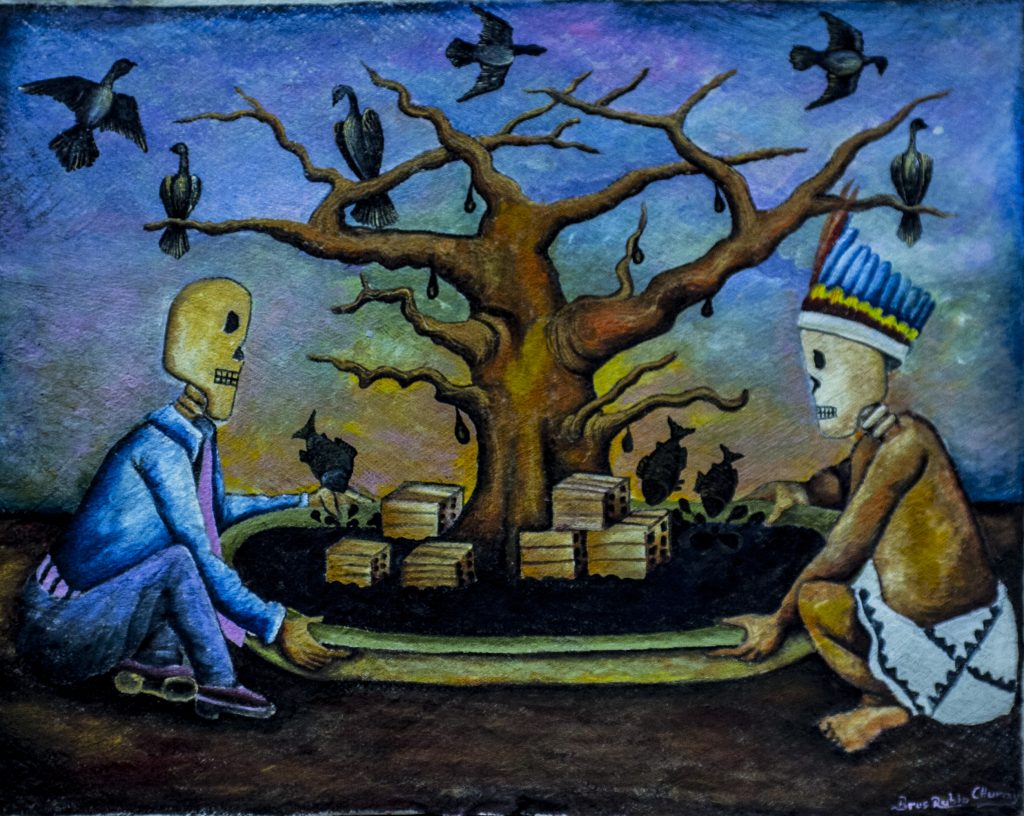
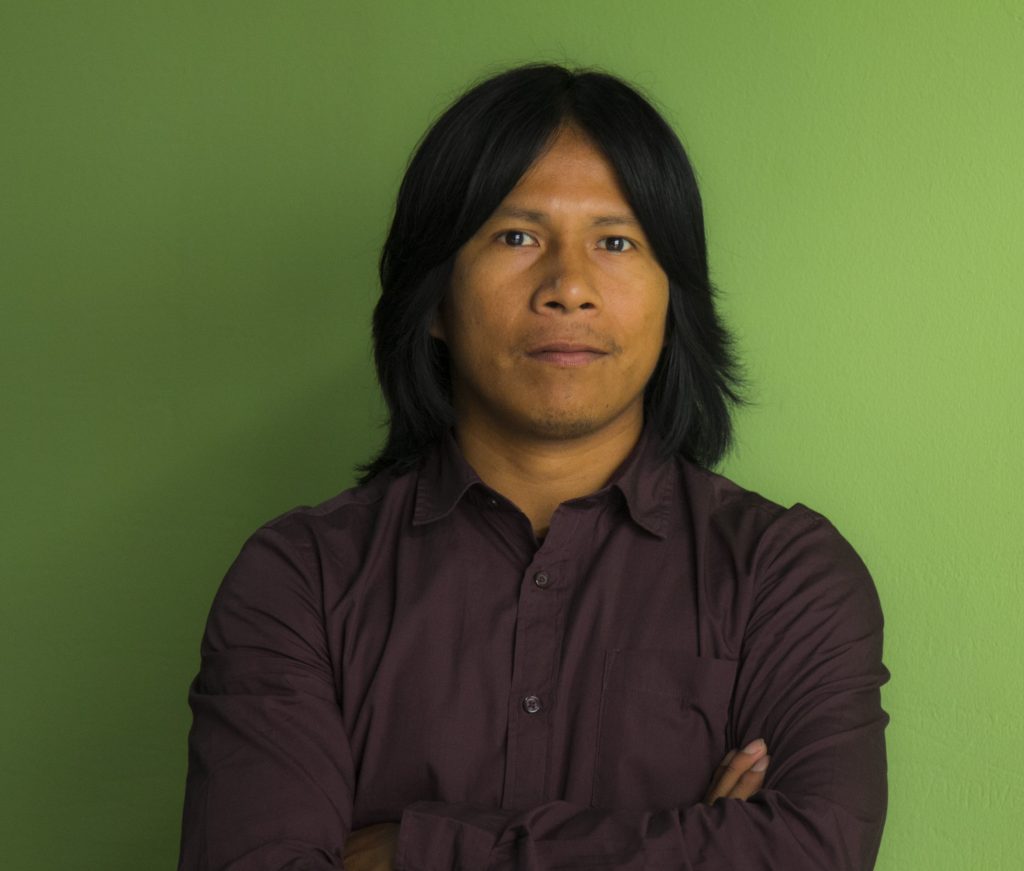
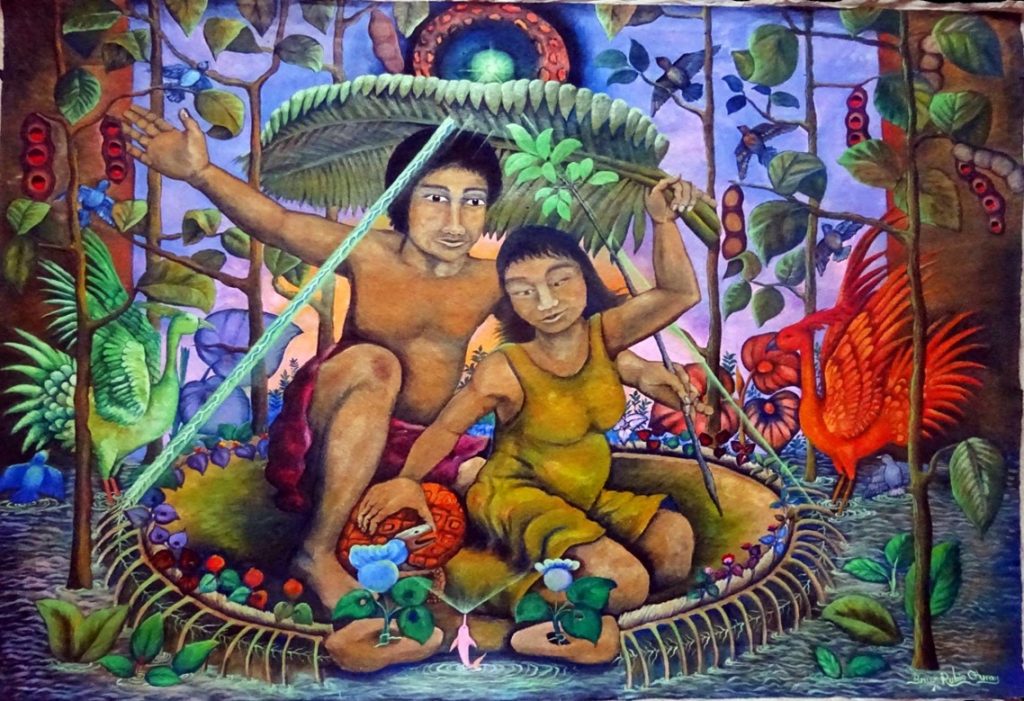
Brus Rubio Churay is a Murui-Bora artist from the Amazon region. He was born in 1984 in the community of Pucaurquillo, located in the basin of the River Ampiyacu, in Loreto, Peru. In his work, natural dyes and acrylic come together on canvas and ‘llanchama,’ the fibrous bark of the ojé tree. In “Our grandfather guiding the children”, the ancient territory / jungle carries the children, keepers of water and dance. Trickstery and joy emanate from the earth in a maze of barks and branches.
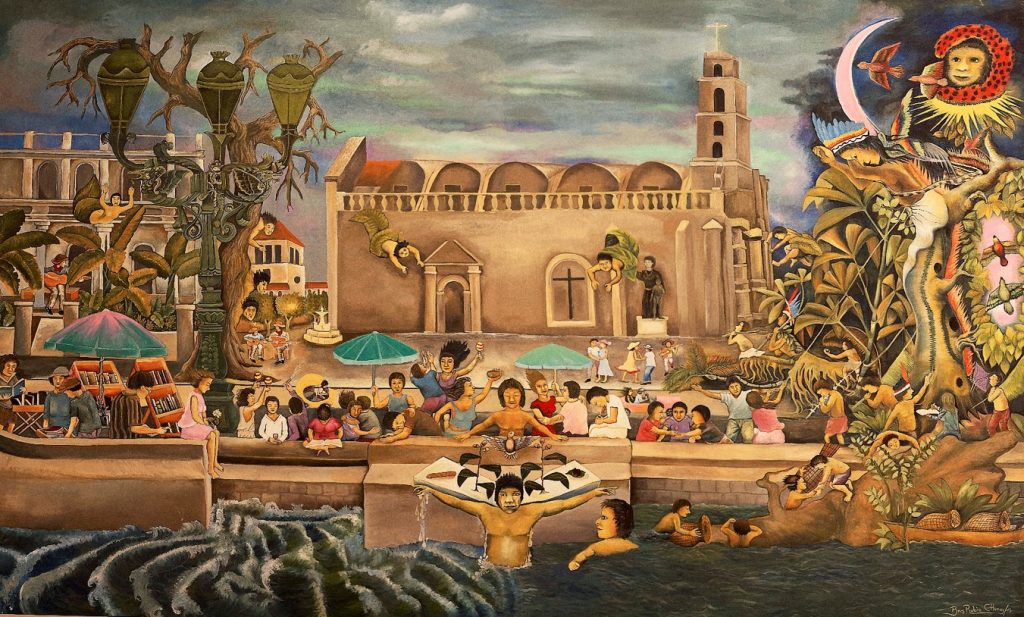
Whether in Miami, Havana, or Paris, the jungle reveals its boa eyes. Rubio’s sight captures the invisible. The world of men fills only a bare snippet of the canvas. Though the waterfront and the beach unfurl all of their human strength, the beings that sustain the image are, and are not, women and men, but the beings who inhabit the canvas alongside tourists, and songs and dances that accompany Salsa.
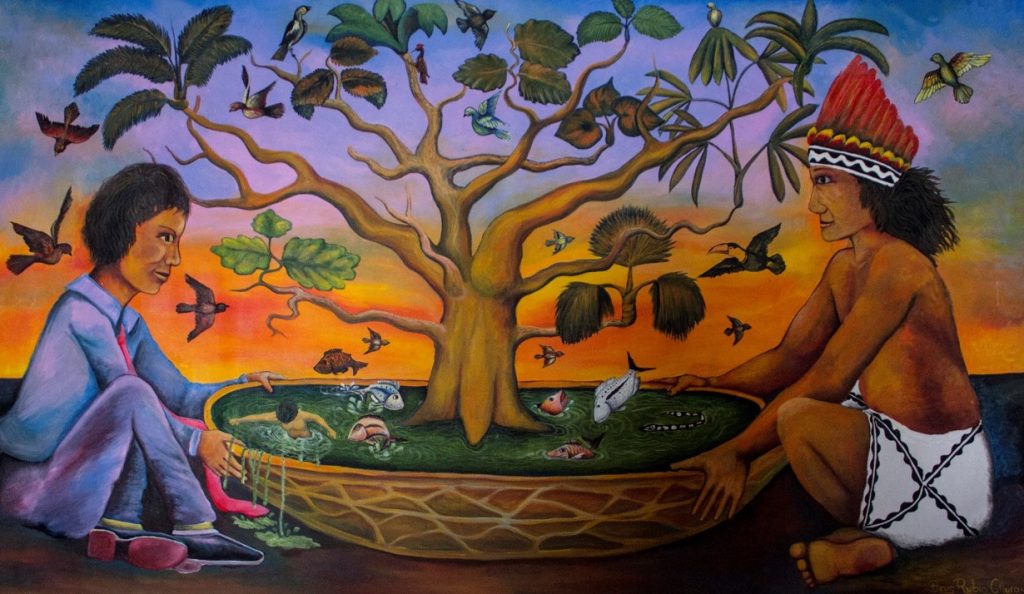
Between the city and the jungle, the Murui-Bora gods of this universe are not mere mythical episodes from a book. They are the curious gaze of Buinaima himself before the indelible structures of a contemporary city. What in the world have men done with the Tree of Abundance? Could it be true that they divide the platters of macambo and petroleum as if there were no consequences? The skeletons of the devourers devour themselves.
“My creation reflects a great cosmic happiness because it is inspired by gods and important mythic people, by festivals and rituals, by the tasks of farming and cooperative work (minga), by the magic and beauty of fish and animals, by the song, vision, and sacred work of my ancestors. All of this is part of my existence, of my way of thinking, feeling, and looking at the world.”
Brus Rubio Churay
“(…) My paintings also address social, historical, and political themes that affect my people and Amazonia in general, such as environmental contamination, the crimes of the rubber barons against my ancestors, corruption, and the outside agencies that impose development programs without understanding the local reality.”
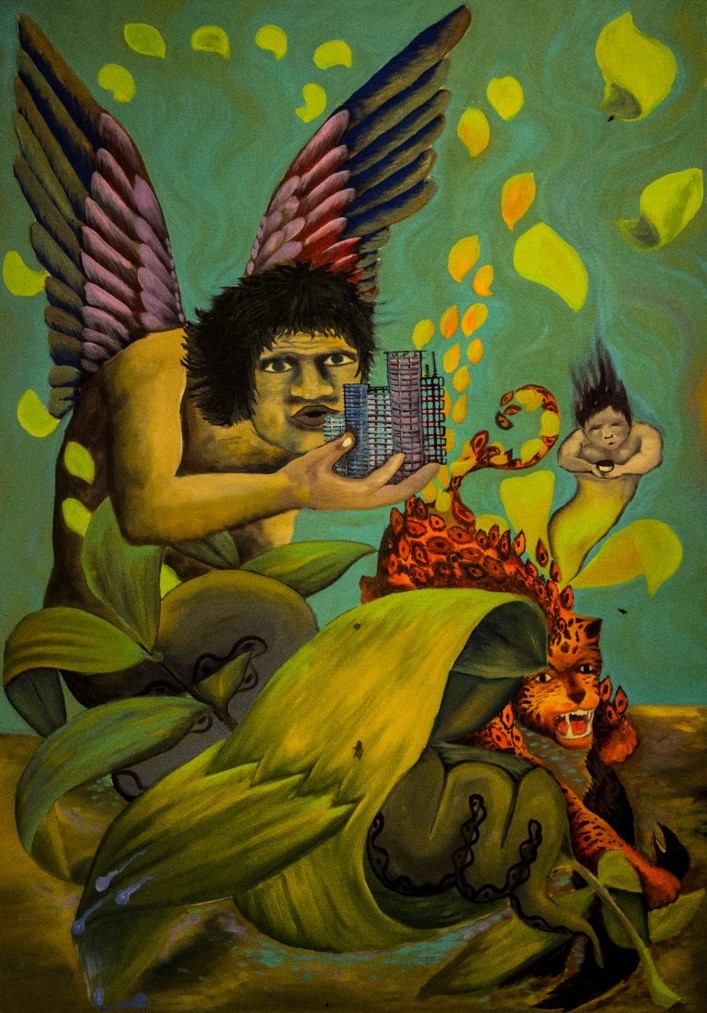
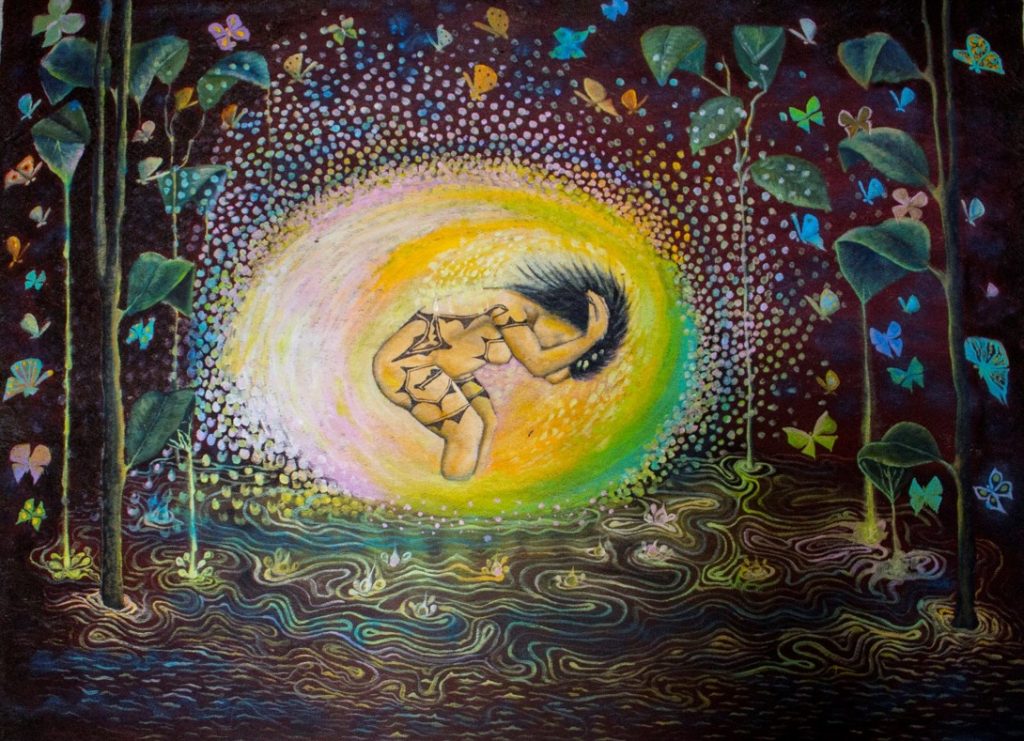
Considered as a whole, the work of Brus Rubio allows long silences for daydreaming (but not for romanticism or exoticism.) The viewer goes from the known (let’s say a leaf) to the orange skin of a jaguar made of falling leaves. Suddenly, colorful butterflies alight upon the Milky Way while the Mother bathes beneath the stars. Eroticism and love linger, buzzing above the waters.
He’s projecting thoughts to a screen for me to read.
I’m at his private film of captivity.
He’s watching us. We’re hunched over heaving the sorrow vomit.
Father stands before me
time without fear suspended and apart
unafraid of anything one way or another.
“When did they cut it?” he wants to know
pushing the thought into space between my eyes.
Raising his pant leg where the mortician
smoothed and stretched the salvage skin Father used for padding
his below-knee amputation
hovering inches above the ground glints in his eyes.
He doesn’t remember the amputation
in the bending.
Father shows me his whole leg. Scars
mended and smooth.
He is an uncut body again. Like before the bending place.
Only the graft scars on his thighs remain.
He projects: “I feel my leg here Margo my foot still itches here” Father
points: “in this empty space” he twirls his fingers a slow spiral.
I nod to him: “I see. I’ll remember this for you.”
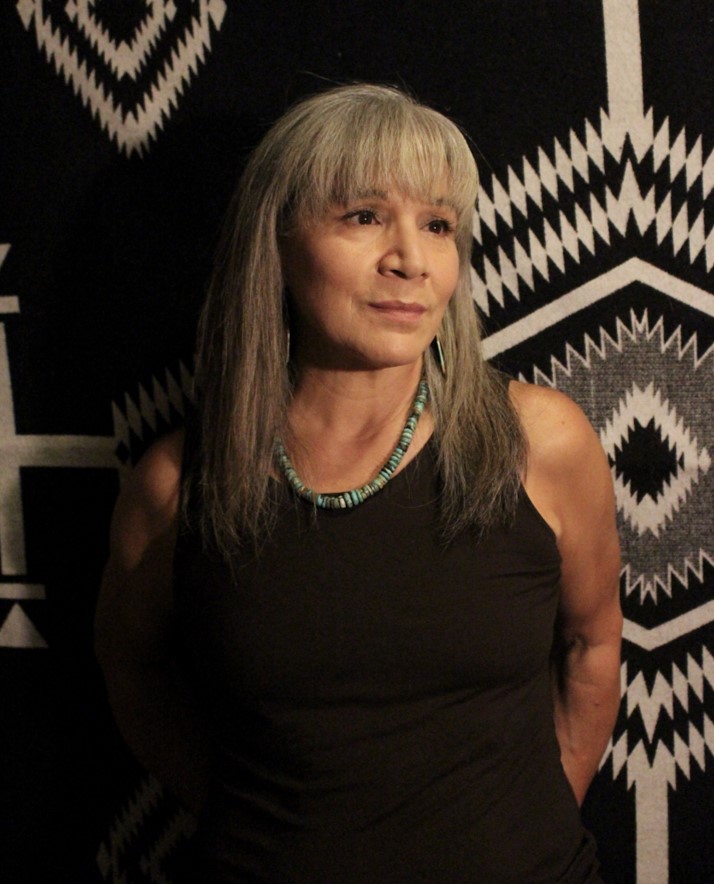
Artist Statement
At a very young age, I suffered a severe hearing impairment brought on by a runaway fever, poverty, and the intergenerational effects of colonization. At the time, there wasn’t the capacity to know if there was mass interest in the effects of the industrial chemical colonization of the air, land, water, and food systems in which I was raised in southern Texas and in the Texas-Mexico bordered region.
Early on, I made linkages between the settler society’s broad disrespect for and war against the Earth and the aggression we experienced as the local, non-recognized, Indigenous peoples. I didn’t have the language for this then; though, I was gaining intuitive knowing about how the oil-cattle-cotton and extraction economies trickled down toxicity to my body and how illness resulted.
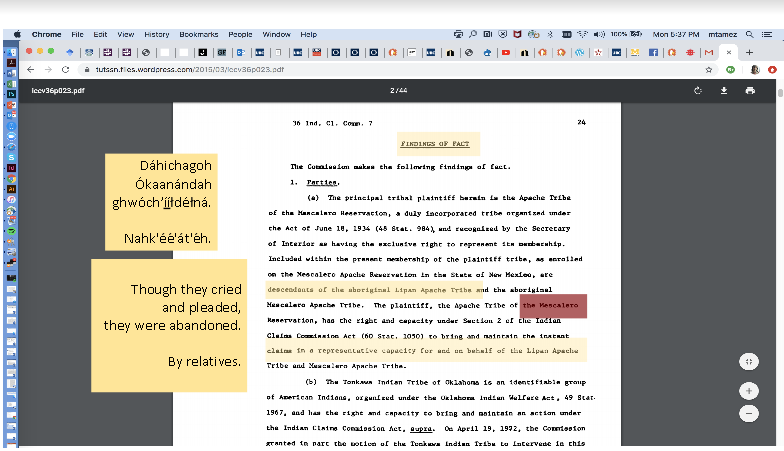
Being Indigenous, poor, from non-recognized Ndé Dene peoples of Kónitsąąíígokíyaa, (aka: Southern Plains Lipan Apaches from the Big Water Country; unceded Aboriginal Title lands in current-day Texas), this also meant that my experiences, understandings, and critique of these interconnections were also linked to difficult histories spoken, or expressed nonverbally, amongst adult family members. Poetics of repressed memory, knowledge, and anxiety about our subjugated and invisible class (non)identity and (non)recognized political personhood raged into the 20th century:
through new Indigenous battle-grounds
waged inside cramped rental houses,
low-wage neighborhoods, school yards,
job sites, compulsory CCD catechism
classes, athletic indoctrinations, Sunday
mass, and public schools with White teachers
and rulers, and rule-line paper, and ruling glares.
through compulsory Brownie and Girl Scout
regimentation, yellow school bus rides, armed check points,
after school detention, signed yellow slips from home,
parents feeling contained in the rule-lined signature line
for their compulsory signing without consenting, that I
am a bad person for telling our people’s version of history,
compulsory silence in classrooms, compulsory seating order
at the back, with another Native and a Black girl,
curfews, canned corn, old tortillas stuck in
frozen wax paper, Halloween stereotypes, hard leather shoe
blisters, jumped by a gaggle of white boys managing
the settler racial architecture of space and place.
First grade in the occupied territory of unceded Lipan Apache homelands,
South Texas.
My work relates my life-long interest in language, history, archives, memory, and Ndé Dene peoples’ resistances and refusals to disappear and go away. My work also engages where and how Ndé Dene peoples have become conditioned into submission to settler supremacy, and where the colonizer’s methods embedded into the colonized. My work, as a truthing instrument, leans toward healing and revitalizing, by way of uncovering the hidden in order for truth to emerge; in order to purpose that which has been hidden and negated to be a vehicle for recovering Ndé Dene peoples’ spirits, well-being, and futurity beyond the non-persons we are imagined to be by colonizers which includes Indigenous peoples. Difficult knowledge and peace building have been core to my art, thinking, and process.
“Difficult knowledge and peace building have been core to my art, thinking, and process.”
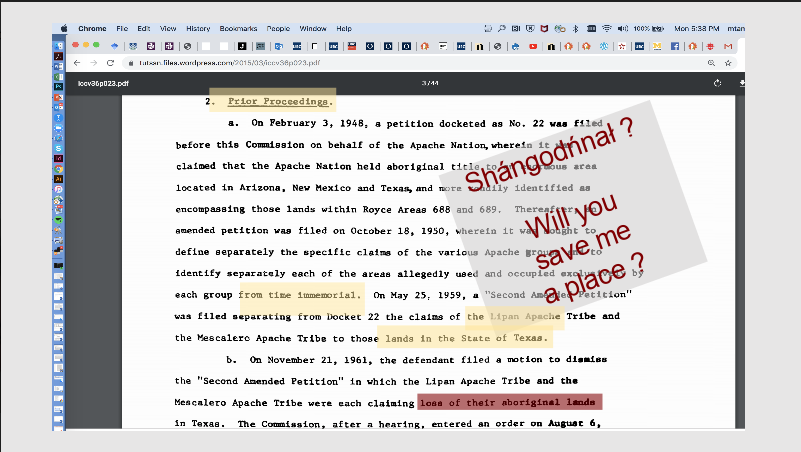
By recognizing that genocide—for Ndé Dene peoples—has intricately involved diverse actors and polities, Indigenous genocide in southern Texas has demanded that poetry ascend to different places and strongly opposes genocide being used as a metaphor, or a generic, abstract descriptor. Genocide is an area of research, developed amongst contemporary Ndé Dene scholars, specific and located within groups of my family and kinship society, my immediate ancestors (embodied in the last four generations, between 1872-2019), as well as specific to sites/places of terror, crisis, violence, atrocity, brutality, indignity to the human body, and organized erasure in Kónitsąąíígokíyaa.
In my work, I engage different ways of knowing (epistemology), historicizing, ethics, and valuing to inform my methodology and creative methods to imagine and construct poetry which gives form and voice to non-recognized Indigenous nations. I reference my research on the state, state actors, bystanders, and specific Indigenous polities, organizations and institutions which have contributed to the process of obstructing Ndé Dene peoples’ access to justice. Poetry is a vital form to address histories and voices relegated as disposable and abject.
The cultural, physical, social, and political personhood of peoples of Kónitsąąíígokíyaa is persistently denied in US society into the present. Being deeply involved in three legal cases, between 2007 to 2013, which firmly rejected the state’s normative myth-making regarding US and bystander complicity in perpetuating genocide acts in Ndé Dene peoples’ unceded and Aboriginal Title lands (Texas) during the violent border wall conflict (2007-2009), I find poetry a useful and dynamic tool for stimulating imagery, animating truth-telling, making space for non-western language and knowledge systems, and igniting fire underneath the sedated and numbed consciousness of US-American society.
As a researcher and scholar, I am an archive builder, curator, and papers manager for two branches of Ndé Dene peoples’ historical documents and culturally related objects. In my current projects am making crucial links between Ndé Dene peoples’ difficult knowledge and state power as warehoused within officially sanctioned archives as an important subject for, (currently updated figures), 400 non-federally recognized Indigenous nations whose political personhood and land claims cases are subjected to multiple forms of human rights violations committed in the US today with the sanction of the federal government, state actors, as well as numerous federally recognized political actors today. This is untenable and is a major motivation in my production in and across poetry, visual arts, language activism, theory, and Indigenous rights advocacies.
The subject in these poems shared with the Siwar Mayu online publication is persistent genocide denial, negation, and obfuscation. As well, I’m interested in exploring the roles and memory of bystanders, beneficiaries, and obstructers to the Ndé Dene peoples’ experiences. I’m exploring Ndé Dene historical memory of complicated emotions connected to being forced by the state and its legal institutions, to helplessly witness the US and other tribal polities take control over unceded Ndé Dene peoples’ homelands. My engagement in Ndé Dene language recovery is a crucial act of honoring my ancestors—the genocide survivors and the non-survivors—and a loving act of reclaiming Ndé Dene peoples’ political, cultural, spiritual, and physical belonging with Kónitsąąíígokíyaa, our customary and traditional homeland. By doing so, the poems re-energize the Ndé Dene peoples’ self-determination and larger belonging amongst the Dene Nation. In poetry, the Ndé Dene peoples ascend to identity beyond the legal subjugated status of ‘Apache’, which is the legal synonym for the settler state’s normalizing genocide as an act of settler state sovereign impunity and immunity from accountability, redress, or recognizing responsibility. These things are hinged and interlocking; not separate.
“The memories of Ndé Dene peoples remain within me through my deep familial bonds and connections with a significant and large kinship society which spans Niguusdzán (North America).”
The memories of Ndé Dene peoples remain within me through my deep familial bonds and connections with a significant and large kinship society which spans Niguusdzán (North America). By recovering and decolonizing the legal archives, and re-purposing Ndé Dene language revitalization, I (re)visit intimate familial places in Lipan Apache (Ndé) homelands, in South Texas, eastern New Mexico, and northeastern Mexico. My ancestors’ spatial time-bending emplaces a pictorial language, helping me decipher historical violence felt by Ndé Dene of Texas.
My poetry acknowledges and draws attention to the lingering impacts of historical trauma which saturate Ndé Dene storied landscapes still obscured by aggressive settler colonial erasure. Spirit memory as sentience, landguage, place, despair—the collective internalization of Indigenous spatial exile—influence my understanding of my peoples’ refusal to settle for the abjection we’re experiencing still today as a result of the genocide politics of perpetrators and bystanders. These poems, echoing post-memory of Ndé intergenerational genocide survivors, explores how historical memory of violence disturbs linear settler literary, history, and narrative structures which have denied Ndé Dene peoples our lived experiences, knowledge, and homelands—even after death. My poetry, inter-ribboned with Ndé Dene peoples’ perspectives of herstory and law, emphatically position different realities, existences, and outcomes which the Ndé Dene peoples will into being.—Margo Tamez













 Hosted by UNC Asheville and the Diversity Action Council